


In 2024, anti-AA/PI hate remained widespread in California during a heated election year.
Nearly half of Asian American and Pacific Islander (AA/PI) adults in California reported experiencing hate last year, according to our latest survey, conducted by NORC at the University of Chicago.
Download Resources
Racism and xenophobia against AA/PI Californians remained high in an anti-immigrant climate.
In an election season rife with racist, anti-immigrant rhetoric, AA/PI communities found themselves caught in the political crossfire.
In our research, we found that racism and xenophobia persisted even in California, which is home to the largest AA/PI population in the nation.
California leads the nation in confronting anti-AA/PI hate – notably, through the passage of the Asian and Pacific Islander Equity Budget in 2021, which directed $110 million to community organizations to prevent hate and provide individual direct services, including mental health, counseling, legal representation, and case management. In 2023, an additional $40 million was allocated to the budget, bringing even more resources to local communities.
Between federal attacks on immigrants and communities of color, and the persistence of anti-AA/PI hate in states like California, the time is now to sustain investment in our communities. Moving forward, Pressing Harms, Persistent Needs reinforces the demand for additional investments in mitigating harm and keeping people safe.
Below is a summary of the key findings from our report. To learn more about the state of anti-AA/PI hate in California, please download the full report above.
Key findings
About half (48%) of AA/PI adults in California experienced some form of hate due to their race, ethnicity, or nationality in 2024.
AA/PI adults in California experienced hate in a number forms ranging from harassment (44%) and institutional discrimination (21%) to physical harm or unwanted contact (11%) and property damage (10%).
In some cases, we saw offenders repeat the same anti-immigrant rhetoric often present in political discourse. AA/PI Californians reported being threatened with deportation, told to “go back” to where they came from, and accused of not belonging in this country.
Person was saying hate speech in a public area. When he saw me enter a restaurant, he said, ‘Enjoy your last meal. You are getting deported.’
Man, Taiwanese
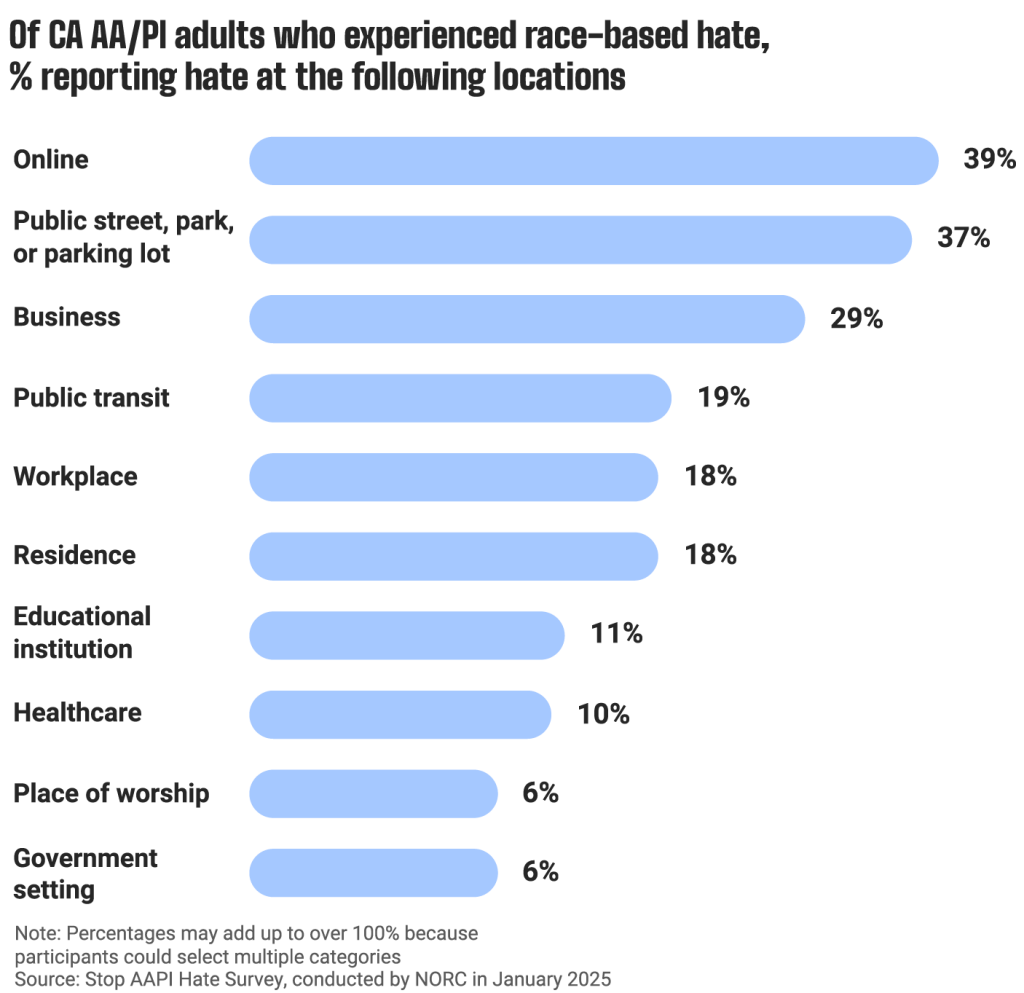
We found that the most common locations of anti-AA/PI hate were online, in public spaces (e.g., public streets, parks, or parking lots), and at businesses.
Nearly one in three (31%) AA/PI adults in California who experienced hate told no one–not even a friend or family member.
Yet, Californians were more likely to speak up than those in other states. 69% shared their experience with someone, compared to 56% outside of California.
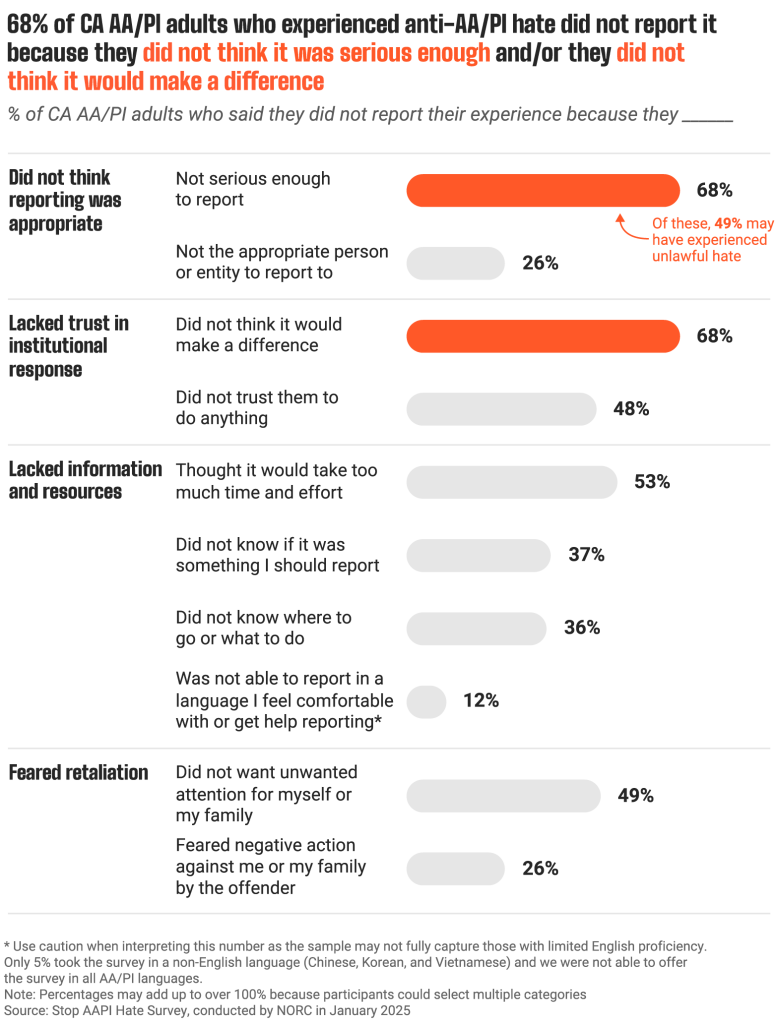
However, formal reporting still remains strikingly low. Just 28% of those who experienced hate reported it formally — even in cases of possible hate crimes or civil violations. So, why do so few AA/PI Californians go on to file a report? A majority of those who did not formally report believed the incident wasn’t serious enough (68%) or that reporting wouldn’t make a difference (68%). Over half felt reporting would take too much time or effort (53%).
Alarmingly, half of those who thought the incident wasn’t serious had actually experienced a potential hate crime or rights violation.
34% of AA/PI adults in California who experienced hate received support, but another 38% needed help and did not receive it.
Though AA/PI adults in California received some support after experiencing hate, our data shows that more is needed. The top areas where respondents reported needing more support included mental health care, safety trainings, legal help, community support, and a supportive work or school environment.
I was taking a run to the mailbox when I was assaulted by a woman screaming obscenities at me. She spat on me and tried to hit me. She only stopped when I brandished my pepper spray at her (having been on heightened alert after all the Asian hate crimes reported in California). We called the police but they told me there was nothing they could do and actively discouraged me from filing a report stating that this would give the woman a way to find me. It’s taken a long time for me to feel comfortable talking about this let alone report it.
Woman, Vietnamese
Two-thirds (66%) of AA/PI adults in California actively worked to reduce or resist racial discrimination in their communities.
Even in the face of persistent anti-AA/PI hate, Californians took action to resist or reduce racism in 2024. These actions included providing support for others who experienced racism, educating others about racism, and participating politically.

At the same time, a majority of AA/PI adults said they anticipate worsening conditions over the next four years under the Trump administration:
- 61% expect greater hostility toward immigrant communities,
- 56% foresee rising racial tensions,
- 57% anticipate more harmful foreign policies,
- And over half (53%) expect an increase in anti-AA/PI hate crimes and hate incidents.
Even in the face of hate, many AA/PI adults plan to engage in policy action in 2025 to combat hate and racism. Nearly two-thirds (65%) say they are extremely or very likely to take action on at least one policy solution.
The implications are clear. The Trump administration shows no sign of stopping its reign of terror against immigrants, people of color, and other vulnerable groups over the next few years.
That AA/PI Californians are committed to the fight against racism and xenophobia is encouraging, but grassroots advocacy is not enough. As anti-AA/PI hate continues to endanger California’s AA/PI communities, we also need state funding and investment in culturally competent mental health care, trauma recovery services, community-based systems of support, and policies that prevent hate and help victims heal.
We call on elected officials, philanthropic institutions, community leaders, and everyday people to invest in and advocate for policies and services that will help our communities through this challenging moment.
Right now, our research and data funding is under attack — to sustain this work, we’re need your help.
AA/PI communities have long been overlooked and underserved. And to make things worse, the Trump administration just unlawfully terminated two million dollars in critical funding for Stop AAPI Hate, leaving our communities more vulnerable during a time when targeted hate is widespread. With your support, we can continue to conduct research into AAPI experiences, build resources to keep our communities safe, and support victims of anti-AA/PI hate and violence.
Learn More
The State of Hate in 2024
Our second annual State of Hate report paints a sobering picture of widespread and persistent anti-AA/PI hate in 2024.

Post-Election Surge in Hate
The re-election of President Trump coincided with an alarming rise of racism and xenophobia against our communities.
