

South Asian communities are facing hate on multiple fronts.
Anti-South Asian racism is on the rise and has been for several years, as political figures ramp up anti-South Asian and anti-Muslim rhetoric. Online forums are rife with racial slurs and threats of violence. And in communities nationwide, South Asian people are facing verbal harassment and other forms of racism, xenophobia, and faith-based discrimination on the ground.
It’s a disturbing trend — one we have seen twice before since 2023. First, when Vice President Kamala Harris announced her presidential run and then immediately after President Donald Trump won his second term in office.
This spring, we started to see a third spike in anti-South Asian hate, amid political tensions between India and Pakistan, national discourse on the H-1B visa program, and Assemblymember Zohran Mamdani’s successful Democratic primary campaign in the New York City mayoral race.
And today, anti-South Asian hate is rising again on multiple fronts ahead of the 2025 elections.
In this edition of Keeping Count, we’re diving into data on the continued escalation of anti-South Asian hate from July through September 2025. We show how and why things are getting worse — connecting the dots between racist rhetoric, discriminatory policies, and acts of anti-South Asian hate.
Slurs and threats of violence continue to spike through September 2025.
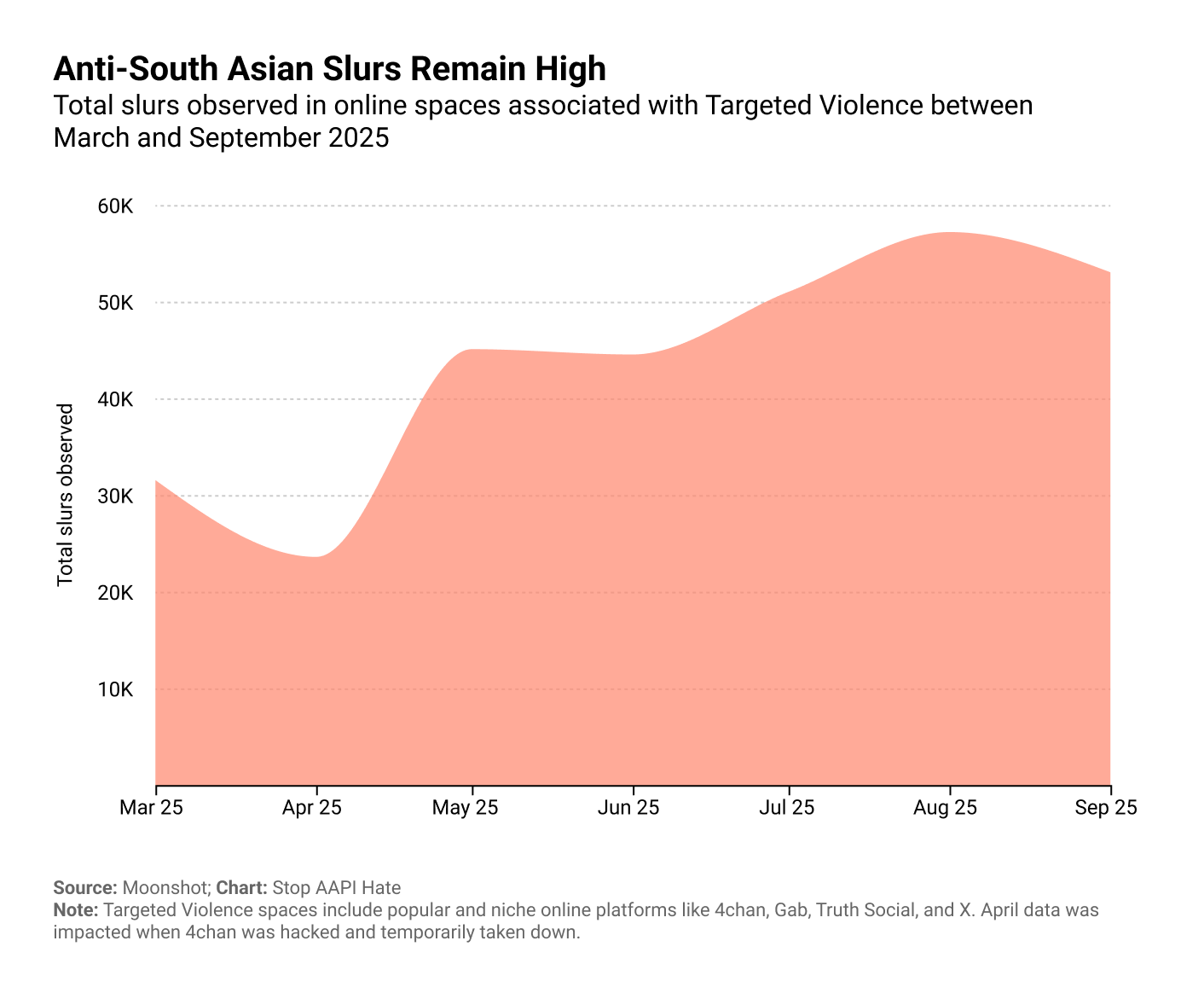
The surge of anti-South Asian slurs that started to take shape in May and June has continued to escalate through July and August and remained high in September, according to data examined by Stop AAPI Hate from Moonshot, which monitors online spaces associated with targeted violence. In August alone, there were nearly 57,200 anti-South Asian slurs — the third highest number since tracking began in January 2023.
Also notable: In September, we saw a dramatic rise of an internet-age anti-South Asian slur, “j**t,” which saw a 69% increase against a 12-month baseline. The term “total paj**t death” saw an alarming 45% increase during the same period.
ℹ️ What in the world is “j**t”? Our blog post on anti-Asian slurs gets to the bottom of it. Read it now.
Anti-South Asian Slurs Remain High
Total slurs observed in online spaces associated with Targeted Violence between March and September 2025
Source: Moonshot; Chart: Stop AAPI Hate
Note: Targeted Violence spaces include popular and niche online platforms like 4chan, Gab, Truth Social, and X. April data was impacted when 4chan was hacked and temporarily taken down.
But the rise of anti-South Asian racism is about more than just slurs. Threats of violence are also a major factor. In August, Moonshot tracked 879 threats against South Asian people, representing the second highest peak since tracking began in August 2024.
❗ The highest peak happened in December 2024 after Trump won the U.S. presidential election. Read what happened here.
Violent anti-South Asian rhetoric continued through the month of September — during which we saw 674 threats of violence, representing a 12% increase against a 12-month baseline.
Threats of Violence Against South Asian People Remain High
Total threats of violence observed in online spaces associated with Targeted Violence between March and September 2025

Source: Moonshot; Chart: Stop AAPI Hate
Note: Targeted Violence spaces include popular and niche online platforms like 4chan, Gab, Truth Social, and X. April data was impacted when 4chan was hacked and temporarily taken down.
ABOUT THE DATA

To complete this analysis, Stop AAPI Hate worked with Moonshot, a group that monitors threats of violence and slurs in online spaces associated with Targeted Violence (TV). They define these spaces “as users, groups, and channels that promote extremist views and narratives.”
This includes popular and niche social media platforms like 4chan, Gab, Truth Social, and X (formerly Twitter).
The numbers don’t lie: the most violent and extremist corners of the internet are littered with anti-South Asian slurs and threats of violence. The question is, why? Here’s what’s behind the continued rise:
H-1B Visa Program Debates and Changes
South Asian people account for 73% of H-1B visa holders in the U.S., and when national discourse turns to the H-1B program, political disinformation about South Asian immigrants “stealing American jobs” often fuels hate against all South Asian communities.
This is not surprising: Anti-immigrant scapegoating is an all too common feature of authoritarian regimes — especially during economic downturns. The same hate and vitriol directed at South Asian workers in 2025 was also directed at Chinese people at the height of Chinese exclusion in the 1880s and Japanese people — first, during World War II and for a second time during the auto industry’s decline in the 70s and 80s.
On September 20, Trump announced a $100,000 fee for certain H-1B visa applicants, sparking online threats of anti-South Asian violence, with users in extremist spaces expressing their support. It’s no coincidence that September 20 also marked the highest single day peak of the use of the “j**t” slur (1,773 mentions) since December 2024, after Trump won the U.S. presidential election.
On one platform, users took their anti-South Asian racism to a new extreme with a targeted campaign attempting to keep Indian H-1B visa-holders from booking return flights to the U.S. before Trump’s H-1B fee took effect.
There is such a strong association between H-1B visa holders and South Asian workers that the term is sometimes treated like an anti-South Asian slur.
For example, on September 12, after an Indian American motel manager in Dallas, Texas was beheaded during an argument, users said he “asked for it” and called him an “H-1B scammer.”
Transnational Anti-South Asian Hate
Anti-South Asian discourse in one part of the world can easily spread to other countries — and even other continents — via social media, fueling threats of violence in the process. We have seen this happen multiple times over the last three months.
In July and August, viral news stories from Canada, Ireland, and the United States fueled threats of anti-South Asian violence online.
On July 11, threats of anti-South Asian violence rose after a social media user posted a picture of South Asian people at a park in Montreal, Canada, insinuating they were sexual predators — a common racist trope.
A few weeks later, we saw a similar rise of violent rhetoric when the Premier of Ontario, Canada announced plans to issue work permits to asylum seekers, which he has since reneged on.
In Dublin, Ireland, a string of violent assaults on Indian immigrants, including one six-year-old girl, went viral on social media, sparking calls to “#beatthej**t anytime and anywhere.”
Just days later, an Indian truck driver in San Bernardino, California was charged with driving under the influence in a fatal multi-vehicle accident. Online, the news escalated into explicit calls to hang and execute the driver. Some users falsely accused Indian truck drivers of drug trafficking. Others demanded the deportation — and even “genocide” of all South Asian people.
Political leaders fuel anti-South Asian hate online and offline.
The return of President Trump has also coincided with high-profile examples of anti-South Asian racism coming straight from the social media feeds and text threads of political leaders — contributing to the overall rise of anti-South Asian sentiment throughout 2025.
In September, Chandler Langvin, a city councilmember in Palm Bay, Florida, faced backlash after disparaging Indian immigrants on social media. Over a period of two weeks, he wrongly accused Indian people of “com[ing] to the U.S. to drain our pockets” and called on the Trump administration government to “deport every Indian immediately.”
Not long after, Arizona State Representative John Gillette called on politicians like U.S. Representative Pramila Jayapal (D-Washington) — who is Indian American — to be “tried, convicted, and hanged.” This was in response to an X video featuring the congresswoman’s remarks about nonviolent political resistance.
These are just a couple of examples of how political leaders have continued to fan the flames of anti-South Asian hate — and this trend shows no signs of letting up.
More recently, POLITICO leaked a group chat from leaders of Young Republican groups. Their conversations were full of racist slurs and stereotypes targeting Black, Latino, and Asian communities, among others. In one thread, a state senator joked that Indian people “don’t bathe very often.” In another, a GOP official praised Hitler, and suggested sending their political enemies into “gas chambers.”
Even when the conversation escalated into direct threats of violence and ethnic cleansing, GOP political leaders downplayed their remarks. Vice President J.D. Vance dismissed the racist content, characterizing the texts as “kids doing stupid things,” although all of the texters were between the ages of 18-40. By refusing to hold their GOP colleagues accountable, political leaders are allowing anti-South Asian hate to continue picking up momentum.
Zohran Mamdani and other South Asian political figures are increasingly targeted with hate
From candidates to federal officials, South Asian political figures are also being targeted with racism, xenophobia, and religious bigotry — hate that’s sometimes even fueled by their peers or colleagues of the same party.
Assemblymember Zohran Mamdani, the Democratic nominee for New York City mayor, is one of the most notable examples of this phenomenon. As an Indian American of Muslim faith, Mamdani has become a popular target for racism, xenophobia, and Islamophobia.
In July, the month after he won the Democratic primary, mentions of Asm. Mamdani on extremist online spaces rose an alarming 949% compared to a 12-month baseline. In September, we saw the beginnings of what appears to be another spike — with an 188% increase compared to a 12-month baseline — most likely in response to the forthcoming general election.
Much of the harmful discourse surrounding his campaign centers on his Muslim faith and his immigrant roots. (Mamdani immigrated to the U.S. from Uganda as a child.) And much of it has originated not just with internet trolls but also media pundits and political leaders.
Days before the November election, U.S. Representative Andy Ogles (R-Tennessee) wrote to the Department of Justice for a second time, repeating earlier calls to denaturalize Mamdani. The reason: false claims of “terroristic ideology” — which most of us recognize as an anti-Muslim dog whistle.
Ogles’ Islamophobic rhetoric echoes that of right-wing media pundits, whose coverage of the mayoral race has often pushed racist fearmongering. For example, Fox Business pundit Maria Bartiromo predicted that New York will look “largely Muslim” under a Mamdani administration.
Such anti-Muslim rhetoric is a significant driver of the recent spike in anti-South Asian hate. From June 24 through October 31, the Center for Study of Organized Hate (CSOH) tracked 35,522 examples of xenophobic and anti-Muslim content on X. This reflects an unprecedented wave of Islamophobic discourse surrounding Asm. Mamdani and his mayoral race — which saw a 450% increase from September to October, just ahead of the general election.
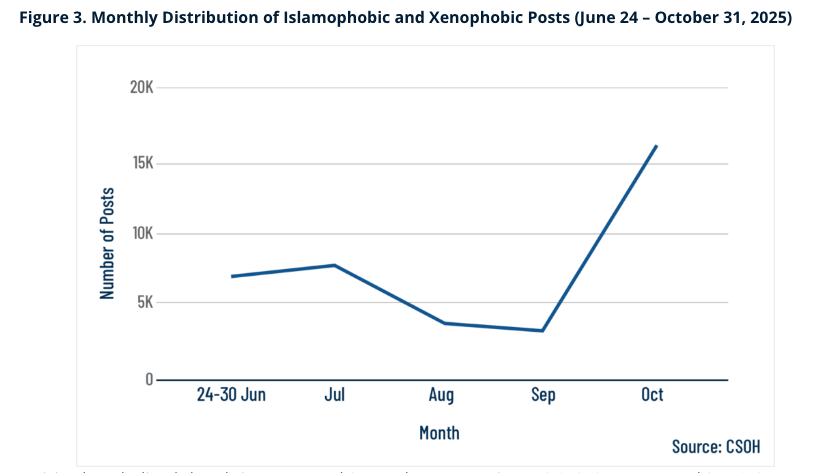
Unsurprisingly, the most dominant narrative was anti-Muslim fearmongering, similar to what we saw from political leaders like Rep. Ogles and media pundits like Maria Bartiromo. Throughout this summer, CSOH researchers observed a growing number of posts characterizing Mamdani as a violent threat via racist and anti-Muslim dog whistles like “terrorist,” “terror sympathizer,” “jihadi,” “Islamist,” and “radical Muslim.”
This tracks with data from Moonshot that shows users pushing similar anti-Mamdani narratives. Some voiced threats to hang all “Muslim terrorists”. Others circulated conspiracy theories — for example, that once elected, Mamdani would mobilize “Hamas armies” against the NYPD.
South Asian Republicans are also targets of anti-South Asian hate and are not shielded from it by their political allegiances.
In October, Trump’s FBI Director Kash Patel, an Indian American and a practicing Hindu, posted a simple message on X in celebration of Diwali. This set off a frenzy of bigotry in the comment section. Some users told him to “Go back to India.” Others were more explicit. Far-right pastor and podcast host Joel Webbon demanded that Patel “[g]o back home and worship your sand demons.”.
Other South Asian Republicans have faced similar backlash. When Harmeet Dhillon, a Sikh American and the head of the civil rights division at the Department of Justice, condemned reports of harassment facing truck drivers from India, Trump supporters were outraged. They accused Dhillon of siding with “her co-ethnics” over the American people and defended anti-Indian racism, claiming “The American dream is for Americans, not Indians.”
The message is loud and clear: no matter their politics, economic background, or immigration status — South Asian political figures still face incessant racial, religious, and xenophobic hate.
Anti-South Asian hate is baked into Trump’s immigration policies.
Not only have Trump’s anti-immigrant policies fueled online hate speech and on-the-ground hate acts, they are, in and of themselves, forms of institutionalized racism.
In September, his administration placed a $100,000 fee on H-1B visa applications — a move intended to shut out South Asian workers, who account for 73% of current H-1B visa holders. The fee also makes it harder for international students to remain in the U.S.
This is despite the fact that, on the whole, research shows that H-1B workers do not “steal jobs” but rather create job opportunities for U.S.-born workers.
THE “IMMIGRANT INVASION”
In case after case of anti-South Asian hate, the same harmful narrative continues to come up.
Earlier this year, the CSOH conducted an analysis of 680 anti-Indian X (formerly Twitter) posts from July through September 2025. According to their research, “deportation, invasion, and job-theft narratives” was not just the most common narrative, but the one that users engaged with the most.
Also notable: U.S.-based users account for 65% of anti-Indian content online. This tracks with the rise of anti-immigrant policies as well as the anti-immigrant rhetoric circulating across U.S. government channels. For instance, a recent post from the U.S. Department of Homeland Security calls on Americans to report “foreign invaders” – language that aims to dehumanize and villainize immigrants and people of color.
Trump-era policies have implications for more than just professional workers. UCLA researchers discovered that during the first six months of the Trump administration, ICE arrested 3,705 Asian immigrants — three times the number of arrests during the same period last year.
Of all the Asian people detained by ICE, Indian and Nepalese immigrants were targeted at some of the highest rates. And in contradiction with the disinformation coming out of the White House, the vast majority of those arrested had no criminal record.
To make things worse, a recent Supreme Court ruling allows ICE agents to arrest people based on their perceived race, accent, or religious faith. Translation: By reinforcing decades of discrimination against people of color in immigration enforcement, the federal government has left South Asian communities more vulnerable than ever to racial profiling, detention, and deportation.
Anti-South Asian hate shows up on the ground and across our communities.
For South Asian communities, the recent rise of racist rhetoric and anti-immigrant policies is evident in the experiences of everyday people.
Across the U.S., South Asian people are reporting verbal harassment, intimidation, and even threats of violence to the Stop AAPI Hate Reporting Center. Here are just a couple of examples.
An Indian woman in Georgia was filling her drinks at a fast food restaurant when:
“[A] lady came up right behind us, mumbling ‘murderers.’ We asked her if she was talking to us, to which her response was to yell at us, screaming ‘you’re murderers, you’re dirty murderers and rapists. I’m going to call ICE on your dirty *sses so you get deported back to India’ (we are all U.S. citizens). … She also attempted to lunge at us. … She kept hovering in our faces and threw food at our feet as she walked out.”
An Indian man in Massachusetts and his roommate were at the laundromat when:
“[A] woman entered the laundromat with two adults who appeared to be her parents. … Without provocation, she began shouting, ‘I don’t want to see ugly, smelly Asians here!’ She repeated this hateful slur loudly and aggressively, targeting us directly. We felt shocked, humiliated, and unsafe. The situation quickly escalated when, out of anger or frustration, she smashed the dryer door, causing the entire glass and frame of the door to come off.”
It’s undeniable that this kind of anti-South Asian hate is becoming more common. In our Stop AAPI Hate national survey with NORC at the University of Chicago, we found that the prevalence of experiencing a hate act based on race, ethnicity, or nationality rose for South Asian adults from 43% in 2023 to 54% in 2024.

The most common kind of anti-South Asian hate: harassment (e.g., threats of harm or racial slurs). In fact, 48% of South Asian adults in the U.S. experienced race-based harassment in 2024, survey data shows.
Other forms of hate based on race, ethnicity, or nationality include:
- Institutional discrimination, which 28% of South Asian adults experienced. This can include unequal treatment from a business owner or government employee.
- Property harm, which 6% of South Asian adults experienced. This can include broken windows or graffiti.
- Physical harm, which 4% of South Asian adults experienced. This can include minor or major physical attacks.
What can we do about anti-South Asian hate?
The implications are clear: Anti-South Asian hate is on the rise, and it’s happening on multiple levels: online and offline; interpersonal and institutional; and in the form of racism, xenophobia, and faith-based discrimination.
With so much on the line for South Asian communities, we must take urgent action. Even in a political climate where progress remains an uphill battle, it’s still possible to hold people in power accountable:
- After Florida Councilmember Langevin posted several anti-Indian social media posts, 100+ residents showed up to a city council meeting — most of them in defense of the local Indian community. Thanks to their advocacy, the Councilmember was officially censured.
- Paul Ingrassia withdrew his nomination to lead the Office of Special Counsel after coming under fire for sending racist text messages (e.g., “Never trust a chinaman or Indian. NEVER.”)
To protect our South Asian friends and neighbors, raise awareness, and hold bad actors accountable, Stop AAPI Hate tracks all forms of racism, xenophobia, and faith-based hate against South Asian communities and all AA/PI communities.
And we can’t do it without the support of everyday people. Your reports make our advocacy possible.
REPORT ANTI-SOUTH ASIAN HATE
If you have seen or experienced anti-South Asian hate — whether in person or on the internet — take a few minutes to submit a report to our Stop AAPI Hate Reporting Center.
This can include harassment, institutional discrimination, property damage, racial profiling, and physical harm as well as anti-South Asian or anti-immigrant political rhetoric or policies.
If you found these data insights helpful, share them with others. If you or someone you know has experienced hate or discrimination, don’t stay silent. To take a deeper look into our research, check out our latest reports at stopaapihate.org/reports.

Keeping Count | Anti-South Asian Hate: It’s Gotten Worse