

Islamophobic and racist slurs targeting Mamdani surged leading up to and after the election, anti-South Asian hate remained high.
On Tuesday, November 4, 2025, Assemblymember Zohran Mamdani made history as the first South Asian and Muslim American to be elected the mayor of New York City. While Mamdani’s win marks a huge milestone for diversity in political leadership, it also serves as a reminder that anti-Asian racism and anti-Muslim hate remain urgent issues today.
From October 1 through November 11, 2025, new data from Moonshot tracked anti-South Asian content targeting Mayor-Elect Mamdani and the broader South Asian community in online spaces associated with targeted violence. And Stop AAPI Hate’s analysis reveals a substantial rise in hate directed at Mamdani that persisted even after Election Day.
ABOUT THE DATA

To complete this analysis, Stop AAPI Hate worked with Moonshot, a group that monitors spaces associated with Targeted Violence (TV) — or users, groups, and channels that promote extremist views and narratives.
The data cited below was collected using simple boolean searches on a select group of common anti-Muslim and anti-South Asian slurs used in conjunction with Mamdani across 4chan, Gab, Patriots.win, and Telegram. In the interest of time, we used different parameters and methods here than in other Moonshot/Stop AAPI Hate research collaborations. Unless otherwise specified, this data should not be directly compared with other data from Moonshot/Stop AAPI Hate.
In terms of hate directed specifically at Mamdani, we saw an alarming 238% increase of anti-Muslim and anti-South Asian slurs between October 1 and November 11. The vast majority were Islamophobic in nature.
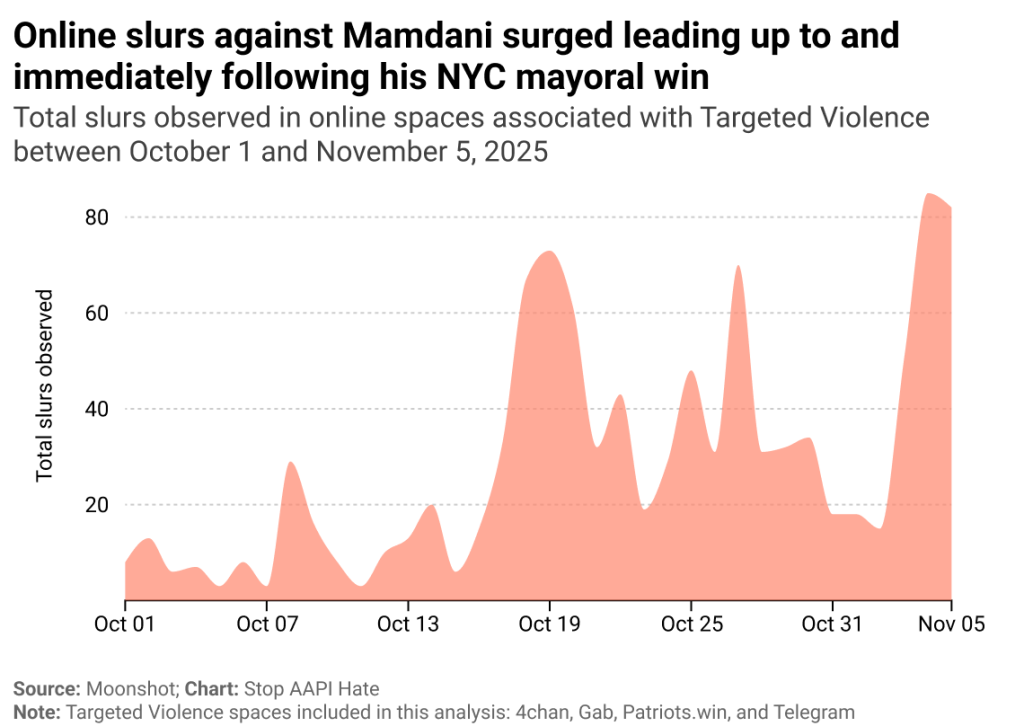
On November 9, four days after the general election, anti-Mamdani slurs peaked at 180 in a 24 hour period. This is 2,150% greater than the number of slurs observed on October 1 and 112% more than Election Day, when we saw the second highest peak.
In this special edition of Keeping Count, we’re delving into the rising tide of anti-Mamdani hate and what is stoking it. Keep reading for more on what we learned.
Islamophobia dominated online discourse surrounding the Mamdani campaign.
Based on our analysis of the 1,566 slurs targeted at Mamdani before and after the election from October 1 through November 11, 2025, 91% of them disparaged his Muslim faith.
Overall, Islamophobic slurs targeting Mamdani saw an increase of 175% between October 1 and November 11, 2025. The first notable spike occurred after the first general election mayoral debate on October 16.
When a political official called Mamdani the “jihadist candidate” in a tweet and “a jihadist who will destroy New York,” we saw a distinct increase in posts connecting Mamdani with “jihad” and “terrorist.” These allegations are baseless and rooted in anti-Muslim sentiment.
Soon after, the New York Post published a slanderous piece recklessly connecting him to a “terror-linked” imam on October 18. Even after the article was widely condemned as Islamophobic fear-mongering, the false narrative about Mamdani’s “jihadist” roots gained traction in violent, extremist corners of the internet.
On November 9, we observed a second spike in anti-Mamdani slurs following the general election. This could have something to do with the growing volume of media coverage surrounding Mamdani’s win.
Many articles, like this one from the New York Post, leaned into anti-Muslim fearmongering, like stating false claims that Mamdani “does not believe in co-existence” and is a threat to Jewish Americans in New York.
Two days beforehand, on November 7, Anti-Defamation League (ADL) also made news for launching the “Mamdani Monitor”, which insinuates without basis that Mamdani is engaged in “antisemitic behavior.” Advocates have since criticized the initiative it as “blatant Islamophobia.”
During this time period, we also noticed a new anti-Muslim slur — “zutt” — used in connection to the Mamdani campaign. Originating on 4chan, it refers to two things: 1) a historical ethnic group from the Indus River Valley and 2) a misreading of an old hadith (i.e., a religious document), in which the Zutt people are described as “riding” the prophet Mohammed. Throughout the reporting period, users invoked “zutt” to sexualize Mamdani and his wife — and to disparage Muslim New Yorkers.
South Asian communities were caught in the crossfire.
Anti-South Asian slurs against Mamdani also rose between October 1 and November 5, but to a lesser degree than Islamophobic slurs — and remained elevated through November 11. In the final five weeks of Mamdani’s campaign, we observed anti-Mamdani posts in violent, extremist online spaces that disparaged his immigration status and his South Asian roots.
Some of the racist posts accused Mamdani of having dual loyalties and “working with brown self-interest in mind.” Others fed into racist stereotypes — e.g., that Indian people are “scammers” and “terrorists”.
We also saw xenophobic posts, for example, one that claimed that the streets would be overrun with immigrants under a Mamdani administration.
But it’s worth noting that Mayor-Elect Mamdani was not the sole target of anti-South Asian hate during this time period.
Slurs directed at the broader South Asian community remained high overall from October 1 to November 11. At the same time, the two most common anti-South Asian slurs — “paki,” “jeet,” and variations of them — showed up 122,789 times.
Notably, anti-South Asian hate remained high from November 4 through November 11 — the week after the election.
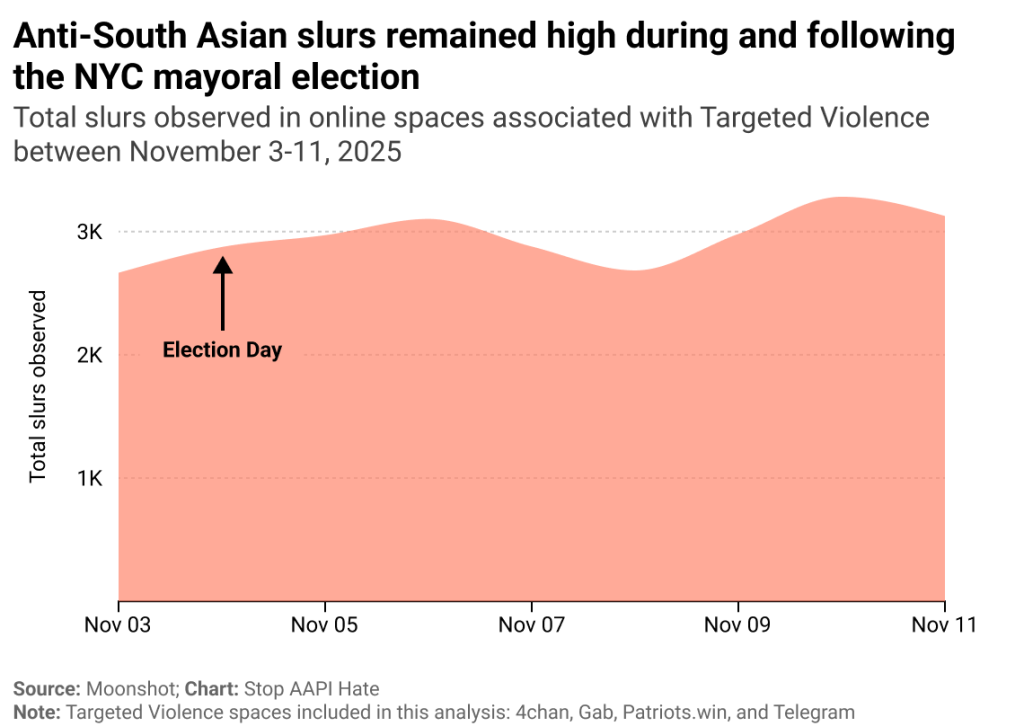
This finding helps confirm that anti-South Asian hate has remained at alarmingly elevated levels since at least the 2024 presidential election cycle – as reflected in Stop AAPI Hate’s previous analyses of similar datasets tracking hate against South Asian communities in extremist online spaces. More recently, Stop AAPI Hate observed an overall rise of anti-South Asian slurs and threats of violence online from July through September 2025.
Implications
The recent surge in targeted online hate against Mayor-Elect Zohran Mamdani did not happen in a vacuum. Anti-South Asian racism has remained on the rise for several years, according to several previous Stop AAPI Hate data analyses. Significant spikes have been fueled by everything from global events and H-1B visa policy announcements to racist, Islamophobic rhetoric from high-profile political figures and now, Mamdani’s political ascendance.
Sadly, anti-immigrant policies and bigoted rhetoric from politicians, media pundits, and other public figures show no signs of abating under the Trump administration. And so long as they continue to use Mamdani as fodder for their racist fearmongering and political gamesmanship, we expect targeted hate against South Asians, Muslims, and Mamdani himself to persist both online and offline.
REPORT ANTI-SOUTH ASIAN HATE
If you have seen or experienced anti-South Asian hate — whether in person or on the internet — take a few minutes to submit a report to our Stop AAPI Hate Reporting Center.
This can include harassment, institutional discrimination, property damage, racial profiling, and physical harm as well as anti-South Asian or anti-immigrant political rhetoric or policies.
If you found these data insights helpful, share them with others. If you or someone you know has experienced hate or discrimination, don’t stay silent. To take a deeper look into our research, check out our latest reports at stopaapihate.org/reports.

Keeping Count | Hate Enters the New York Mayoral Race