

Amid the Trump administration’s attacks, international students fear surveillance, visa revocations, and detention.
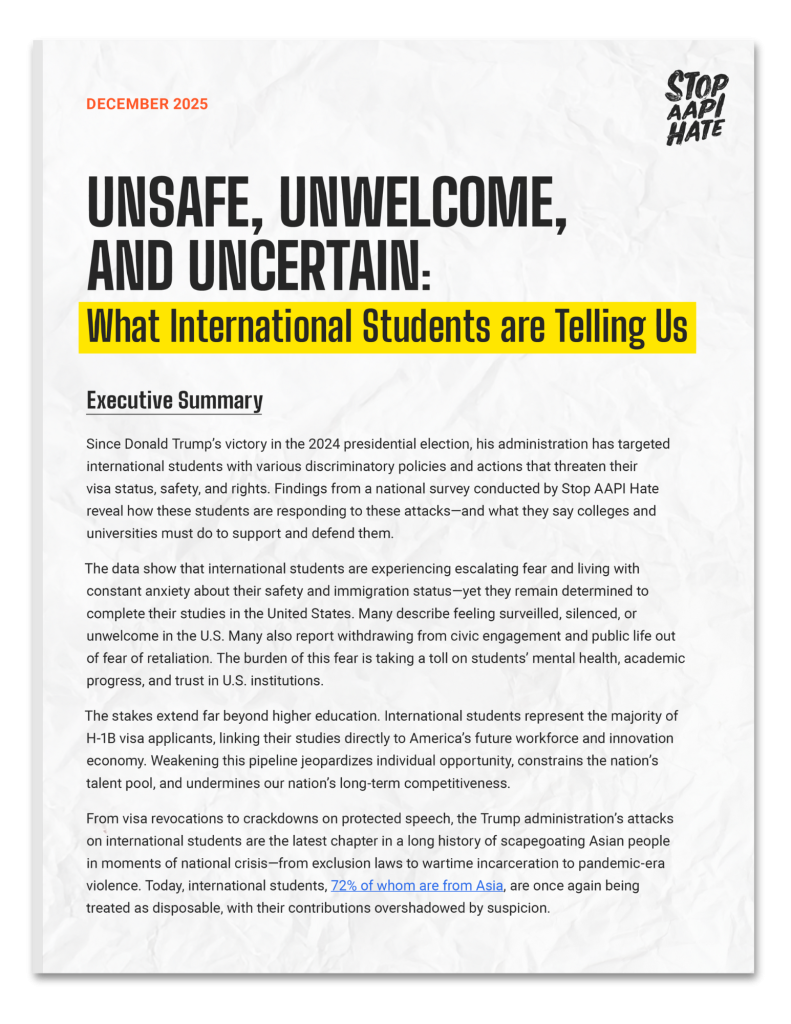
The Stop AAPI Hate report, Unsafe, Unwelcome, and Uncertain, reveals the severe emotional, academic, and immigration-related challenges that international students face with escalating xenophobia and policy volatility.
Download Resources
Following Trump’s return to office, international students are forced to grapple with federal attacks on education, immigration, and free speech.
Since Donald Trump’s victory in the U.S. 2024 presidential election, international students have been a central target of his administration’s anti-immigrant agenda. From unjust censorship and surveillance to arbitrary visa revocations and ICE abductions, the federal government’s attacks have fueled the spread of fear and uncertainty on campuses nationwide. And with a vast majority of international students coming from Asian countries (72%), these attacks have deep implications for Asian communities in America and beyond.
Unsafe, Unwelcome, and Uncertain draws on qualitative and quantitative data from a national survey of 87 graduate and undergraduate international students from 36 U.S. colleges and universities. Findings reveal vast majorities of international students report feeling discriminated against, surveilled, and pushed into silence in an increasingly hostile political climate.
Keep reading for more on what international students are going through and how college and university leaders can help them feel safe and supported.
Key Findings
Immigration policy changes have deep impacts on various aspects of their lives.
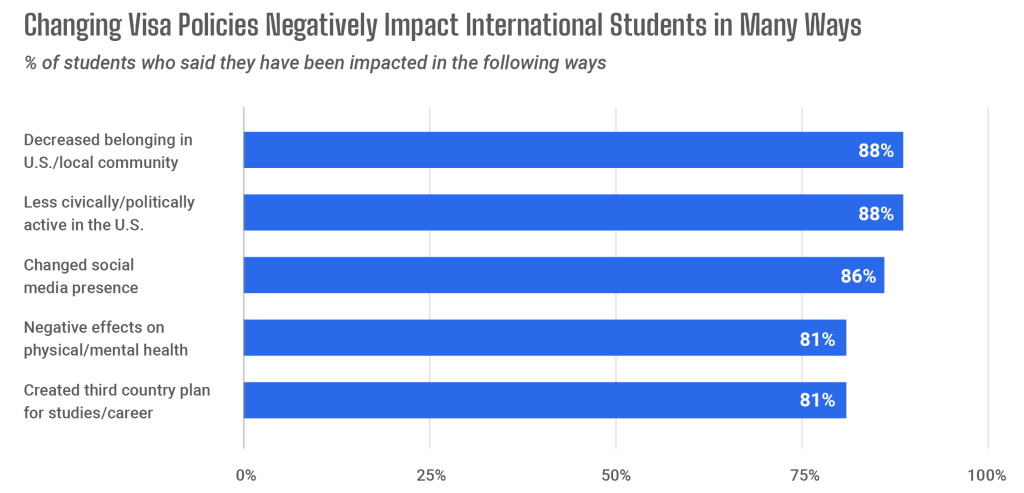
Ever-shifting immigration and visa rules have created a ripple effect across the daily lives of international students.
As a result, many students report feeling a decreased sense of belonging (88%), scaling back their political engagement (88%), and/or changing their social media presence (86%).
International students fear deportation, loss of freedom, and academic and professional prospects.
Across the board, data shows that fear and uncertainty is pervasive among international students. Just 4% reported feeling “very or extremely safe” in the U.S. in the current climate while 90% said they were either “moderately,” “very,” or “extremely fearful” about their student visa status.
What are they afraid of specifically? According to student testimonials, concerns cluster around three general themes.
1. Unlawful detention or deportation
Many feared the threat of sudden detainment or deportation without due process, at times citing Trump administration policies like family separation and third-country deportations.
[I’m scared of] being kidnapped by ICE without due process, being disappeared into the detention system, [and] being denied healthcare if detained.
[I’m scared that] my daughter gets taken away somewhere I don’t know.
2. Increased surveillance and loss of freedom
Students, particularly those from China, reported heightened fears of being watched, silenced, or targeted as a national security threat in a chilling repeat of Japanese American incarceration during World War II.
My worry is that… [t]hey are going to build a camp and put all of us in there like what the government did to the Japanese during WW2.
3. Impact on their academic or professional careers
In the face of recent attacks on international students, many respondents felt nervous about their future prospects and visa status in the U.S. — all too aware that a single rule change could erase years of academic effort or jeopardize their professional opportunities.
It feels like my world can be taken away from me any moment.
[I fear] not being able to secure employment or an H-1B sponsor.
International students lack effective, accessible, and responsive on-campus support.
Most international student respondents reported that their institution provided at least some basic services, including mental health services, travel guidance, and updates about changes to student visa policies. However, our research uncovered significant gaps in services and awareness.
Just 48% said that their college or university offered guidance on completing their studies and only 38% said their college or university offered legal aid — a critical resource given the current policy climate.
Between 14% and 37% of students said they were unsure whether key services even existed on campus — suggesting that more can be done to help them find and access existing resources, or navigate their individual situations.

While colleges and universities have laid important groundwork, they must go further to ensure that support systems are not only present, but visible, accessible, and truly responsive to the lived realities of international students.
International students warn others not to come to the U.S.
Views of U.S. higher education have soured among respondents — due in part to federal attacks on international students and other immigrant communities. One student accused the U.S. government of treating them like a political football or a scapegoat for the current economic crisis. “[I] feel…disrespected,” they added, “instead of being considered at least as human beings.” Other students had a similar assessment.
America is no longer the land for dreams.
We don’t belong here.
When asked what advice they would offer to future student visa applicants, respondents were just as discouraging.
“Run, don’t come,” one student warned. Another responded, “The U.S. is in a deep crisis” and “you need to rethink your decision.”
Recommendations
In light of the growing fear and cynicism among international students, colleges and universities who want to regain and retain their trust need to step up. The path forward might include:
Strengthening support for international students
- Ensure that mental health care is accessible, confidential, and welcoming to international students.
- Connect them with trusted legal information and pro bono or low-cost services, so no one is left to navigate shifting federal policies alone.
- Offer flexible emergency funds to cover unexpected travel expenses, legal fees, or visa-related disruptions.
- Ensure that international students are aware of what resources are available through clear and consistent communication.
Communicating clearly and proactively
- Issue timely, plain-language updates on visa rules, travel guidance, and policy changes, giving students the ability to plan with confidence rather than panic.
- Organize Know Your Rights sessions to prepare them for encounters with immigration enforcement or unexpected policy changes.
- Equip advisors, faculty, and departmental staff with the information they need to address common concerns and direct students to accurate, up-to-date resources.
Ensuring academic continuity and flexibility
- Offer flexible options for international students, including online or hybrid courses during travel disruptions and adaptable enrollment timelines during visa delays.
- Recognize immigration-related stress as legitimate grounds for deadline extensions.
Demonstrating public leadership
- Act together with peer institutions to challenge federal policies that threaten international students and clarify their real-world impacts.
We are able to continue publishing research like this because of the generous support of people like you.
Your donation to Stop AAPI Hate helps us conduct research and analysis on AA/PI communities — and sustains our fight to build a fairer, more equitable future for all.
Learn More

International Student Resources
Anti-immigrant hate is anti-AAPI hate. Join the generations-long fight to defend immigrant communities.

Immigration Updates
What Asian and Pacific Islander H-1B and student visa holders need to know about recent changes to immigration policy.
