

Trump’s anti-immigrant agenda is having far-reaching effects on Asian and Pacific Islander (A/PI) communities.
ICE arrests of people from A/PI countries under Trump are almost four times what they were under Biden, according to our analysis of ICE data. And that’s just the tip of the iceberg.
In a January 2026 national survey conducted with NORC at the University of Chicago, we found that half of A/PI adults in the U.S. said they or another person in their community (e.g., friends, family, and coworkers) were impacted by anti-immigrant policies or sentiment in the past year.
ABOUT THE DATA

Using NORC’s Amplify AAPI panel, the nation’s largest, most representative public opinion panel of Asian and Pacific Islander communities, we surveyed 1,378 A/PI adults in the U.S.
The survey was conducted in English as well as Mandarin, Cantonese, Vietnamese, and Korean — the most common languages spoken by non-English speaking A/PI adults.
Using government data provided by ICE to the Deportation Data Project in response to a Freedom of Information Act (FOIA) request, Stop AAPI Hate analyzed A/PI arrests, detentions, and deportations.
From political rhetoric to federal policies, xenophobia is pervasive, and it endangers A/PI people nationwide, regardless of their immigration status.
In this edition of Keeping Count, we’re going to dive into what our latest data tells us about the different ways A/PI people are feeling the impact of Trump’s anti-immigrant agenda.
Trump’s anti-immigrant agenda takes a toll
For A/PI communities, the resurgence of xenophobia today has not gone unnoticed. 53% of A/PI adults in the U.S. said they or another A/PI person in their community (e.g., friends, family, and coworkers) were impacted by recent immigration policies or the rise of anti-immigrant sentiment.
And diving deeper into the data, it’s clear Trump’s anti-immigrant agenda has brought significant harm to our communities:
- 45% of A/PI adults feel overall less secure in the United States.
- 39% report withdrawing from public life.
- 24% say they face economic or educational repercussions.
- Respondents who report feeling the impact of Trump’s anti-immigrant agenda are 1.9 times more likely to experience higher rates of moderate or severe anxiety and depression.
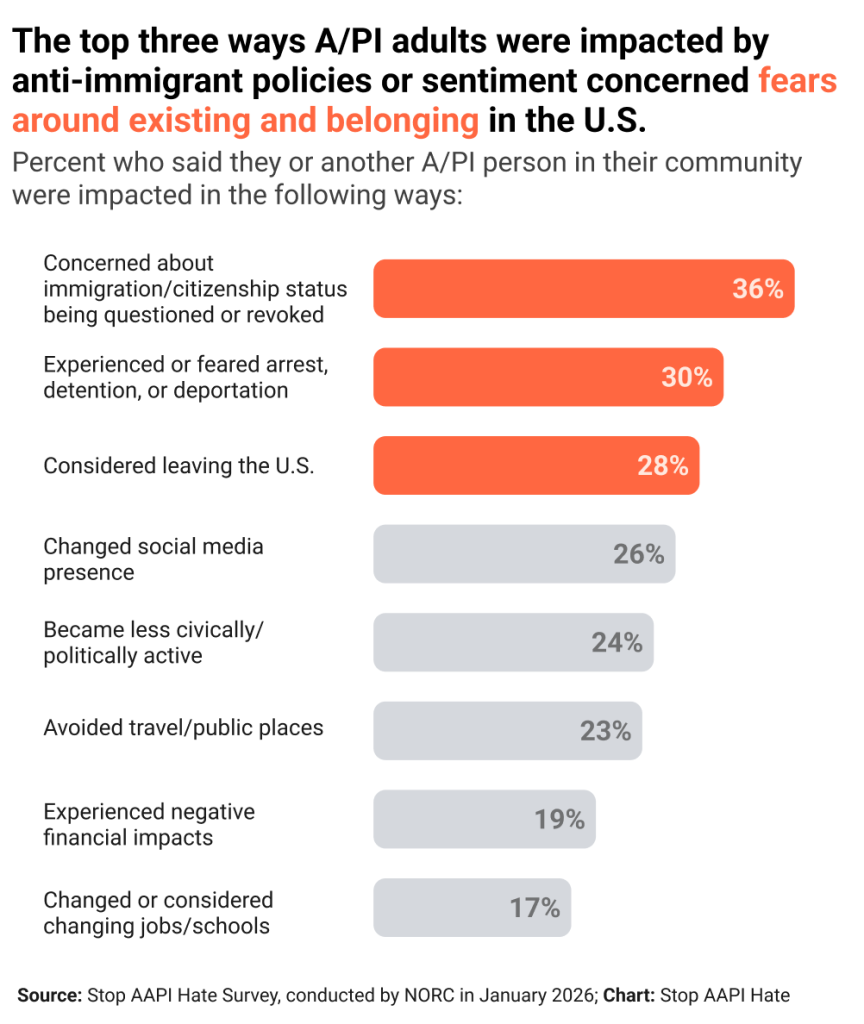
The chart illustrates a more detailed look at the impacts.
1. A decreased sense of security
Many A/PI adults have had their lives and futures in the U.S. disrupted already — or are concerned they will be — as a result of the Trump administration’s anti-immigrant policies and rising anti-immigrant sentiment.
36% of respondents said either they, or another A/PI individual they personally know, had their immigration or citizenship status questioned or revoked — or feared it might be.
As a Hmong American man from California reported to Stop AAPI Hate:
We arrived at [a national park], paid our fee, then the attendant asked us if everyone in our car was a U.S. citizen after she took a look at us. They charged per car, not per person; she had no right to question us in such a way. There were no signs and reasons given.
Meanwhile, 30% experienced or feared arrest, detention, or deportation, and 28% have considered leaving the U.S. altogether or prepared to do so.
Asian and Pacific Islander ICE Arrests, Detentions, and Deportations
From January 20 to mid-October 2025, 7,752 ICE arrests, 7,243 detentions, and 2,776 deportations involved A/PI people.
Asian:
- 7,580 arrests, 7,069 detentions, and 2,631 deportations involved Asian people in that time period.
- The top 5 countries of citizenship for Asian arrests were: China with 26% (or 1,991 arrests), India with 25% (or 1,920 arrests), Vietnam with 12% (or 944 arrests), South Korea with 5% (or 388 arrests), and Laos with 4% (or 336 arrests).
Pacific Islander:
- Meanwhile, 172 arrests, 174 detentions, and 145 deportations involved Pacific Islander people in that time period.
- The top 5 countries of origin for Pacific Islander arrests were: Federated States of Micronesia with 51% (or 88 arrests), Marshall Islands with 31% (or 53 arrests), Tonga with 5% (or 9 arrests), Samoa with 4% (or 7 arrests), and Palau with 3% (or 6 arrests).
Source: Government data provided by ICE in response to a FOIA request to the Deportation Data Project (DDP) and analyzed by Stop AAPI Hate.
Methodology: Arrest counts include those that did or did not result in detention. Duplicates were removed using DDP’s duplicate flag. To count detentions and deportations, we used DDP’s methodology to join arrests data with detention stays data. Detention counts span January 20, 2025 through October 15, 2025, regardless of when the corresponding arrest occurred. Similarly, deportation counts span January 20, 2025 through October 15, 2025, regardless of when the corresponding arrest or detention occurred.
Their fear is not unfounded. ICE arrests of people from A/PI countries were about 4 times higher under Trump than under Biden, rising from 1,998 in January-October 2024 to 7,752 during the same period in 2025.
2. Withdrawal from public life
The growing fear of arrest, detention, and deportation has also compelled many A/PI people to withdraw from public life.
26% of survey respondents said they or an A/PI individual they personally know changed their social media presence. Meanwhile, 24% became less civically or politically active, while 23% avoided travel or public places — likely to avoid unwanted and unnecessary scrutiny by the government.
Stop AAPI Hate has heard from multiple people who were targeted in public because of their perceived immigration status. Here are just a couple of stories we have received through our hate act reporting center:
- A multiracial Pacific Islander man commented on a social media post related to the release of dolphins to the wild. Then, he said “some guy posted that I should be locked up in concrete and do tricks. … [and] proceeded to post that they are reporting me to ICE (I’m a citizen), and I should get my papers ready. Is this 1930s Germany? I fear for my safety with the current ICE raids.”
- A Korean woman from Los Angeles was waiting in line at a fast food restaurant when a woman started screaming at her. The woman wrote, “She got inches from my face… and said she can’t wait until Trump deports me like he promised.”
- An Indian woman was giving a virtual public lecture when someone verbally attacked her during the Q&A. The woman recalled, “She hurled insults at immigrants coming into her neighborhood and taking jobs and reminded us this was her home. [She] called immigrants ‘illegal’ and said we stole jobs, forced people out of neighborhoods, etc.”
Such reports coincided with federal efforts to expand digital surveillance, retaliate against immigrant protestors, and send ICE agents into schools, hospitals, and places of worship.
3. Economic and educational impacts
In addition to impacts on their civic and social lives, some A/PI adults in the U.S. also faced economic and educational repercussions as a result of growing anti-immigrant policies and sentiment.
19% of A/PI respondents said they or an A/PI person in their community suffered financial losses while 17% changed or considered changing jobs or schools — perhaps because of visa restrictions or impending immigration raids, to name a few examples.
Thi Dua Vang, a Hmong immigrant from St. Paul, Minnesota, is one of them. In recent months, ICE arrested her without explanation. She was released from detention two weeks later but the damage was already done: Vang lost her job following her arrest and is now saddled with thousands of dollars in legal fees.
4. Significant mental health toll
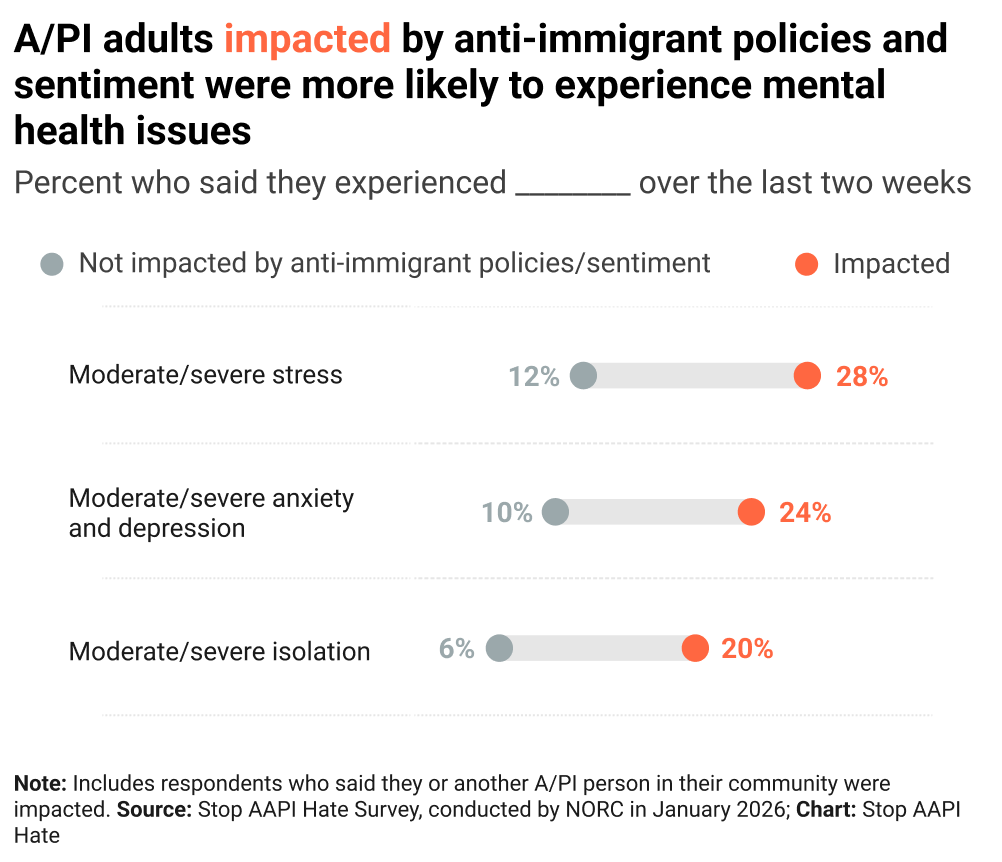
The mental health toll of Trump’s anti-immigrant agenda is also deeply concerning. In the U.S., A/PI adults who felt the impact of anti-immigrant policies and sentiment either directly or in their communities were 1.9 times more likely to report moderate or severe anxiety and depression, as opposed to those who did not.
They were also 2.1 times more likely to report moderate or severe stress and 3.2 times more likely to report moderate or severe feelings of isolation, as opposed to those who did not.
U.S. citizens are also in the line of fire
Our data shows that across A/PI communities in the U.S., both citizens and non-citizens are just as likely to report negative impacts from anti-immigrant policies or sentiment on them or an A/PI individual they personally know (53% vs. 55%).
This trend holds regardless of where people were born. In fact, U.S.-born and foreign-born respondents reported harm at identical rates (53% vs. 53%).
Take, for instance, what happened to one Indian woman at a restaurant in Georgia:
While we were filling our drinks, [a] lady came up right behind us, mumbling ‘murderers.’ [When] we asked her if she was talking to us, [she screamed] ‘you’re murderers, you’re dirty murderers and rapists. I’m going to call ICE on your dirty -sses so you get deported back to India’ (we are all U.S. citizens). … She also attempted to lunge at us. … She kept hovering in our faces and threw food at our feet as she walked out.
The bottom line is that legal status and birthplace offer little protection from the Trump administration’s anti-immigrant agenda. This finding reinforces the fact that xenophobia and racism are deeply intertwined for many A/PI communities.. It’s something that scholars describe as the “perpetual foreigner” stereotype — the tendency to treat A/PI people as outsiders irrespective of citizenship or immigration status.
Here are the immigration policies impacting A/PI communities
Trump’s anti-immigrant agenda — which is unprecedented in scale, scope, and severity — has had sweeping effects on A/PI people who call or hope to call the U.S. home. President Trump ran on a white nationalist political agenda: one designed to make immigrants and people of color feel unsafe and unwelcome in our own neighborhoods.
Since he returned to power, Trump and his senior officials have wasted no time restricting who is allowed in the United States; sanctioning racial profiling in immigration enforcement; deporting people to dangerous places; and violating the constitutional and civil rights of countless people.
For new immigrants:
- He banned travel and froze visa processing for 13 Asian countries and 2 Pacific Island countries at a time when Asian immigrants account for almost 40% of the family visa backlog.
- He added an exorbitant $100,000 fee to new H-1B visa applications, cutting off an essential immigration pathway for A/PI immigrants.
- He ended temporary protected status for Afghan, Burmese, and Nepalese communities, tearing apart hundreds of mixed-status families and putting thousands in danger of violence and persecution abroad.
- He subjected pre-admitted and pre-vetted refugees to wrongful detention and interrogation, including many Hmong people in Minnesota.
For detained immigrants:
- He re-opened dozens of immigration detention facilities and expanded the detained population to a record high of about 73,000 people.
- He made 2025 the deadliest year in two decades of ICE history. Under President Trump, 41 people died in ICE custody, including 9 Asian immigrants.
- He deported hundreds of people to remote prison camps in third countries where they have no ties. Chinese, Indian, and Vietnamese immigrants are among those sent to Ecuador, Eswatini, and Sudan — which have horrific human rights records.
For broader communities:
- He authorized ICE agents to raid schools, hospitals, and other sensitive locations, and detain people without a judicial warrant.
- With the support of the Supreme Court, he also encouraged racial profiling by ICE agents during immigration raids, putting all communities of color at risk of targeting or arrest.
- And he attempted to terminate birthright citizenship in an executive order that threatens to disenfranchise the next generation of A/PI people.
All of these policies are bolstered and animated by horrendous anti-immigrant rhetoric from the Trump administration and Trump-aligned elected officials.
- Throughout 2025, DHS incorporated racist dog whistles into its massive ICE recruitment campaign. “Destroy the flood,” reads one controversial graphic — a reference to a brainless, evil, and parasitic monster from the Halo video game franchise.
- After an Afghan immigrant shot a national guardsman last fall, Trump went on a racist rampage, saying “there’s a lot of problems with Afghans” and decrying Somalian people as “garbage.”
- Trump’s allies have gone even further. When Mayor Zohran Mamdani won his election last November, Rep. Andy Fine threatened to denaturalize him. Aaron Reitz, the GOP candidate for Texas Attorney General, made similar threats against Senator Gene Wu.
When it spreads on social media or through mainstream media, this kind of rhetoric can fuel a broader rise of hate and violence. This was true during the COVID-19 pandemic, when Trump’s repetition of the slurs “China Virus” and “Kung Flu” fueled anti-Asian racism and it has remained true throughout his second term.
Conclusion
The numbers tell a story, but so do the people behind them. Across the U.S., A/PI adults of all ethnicities and statuses are feeling the weight of anti-immigrant policies and political rhetoric. Not even citizens are immune from the fear and uncertainty that the Trump administration has unleashed.
The good news is: we’re prepared to do something about it. 67% of U.S.-based A/PI adults said they are motivated to protect immigrant communities. Here are just a few examples of how A/PI people have recently taken action:
- When ICE agents started racial profiling Asian people in Minnesota, the organization Asian Americans/Pacific Islanders in Philanthropy (AAPIP) launched the Twin Cities Rapid Response Fund, to direct resources to local organizations and advocates in need.
- When DHS started expanding immigrant detention facilities, Japanese American survivors of World War II-era incarceration rallied together to shut them down.
- When President Trump announced a $100,000 fee for future H-1B visa applicants, South Asian American advocates joined a multiracial coalition of healthcare providers, labor unions, schools, and religious organizations to file a lawsuit against the administration.
The fact is, more and more A/PI people are showing up to stop Trump’s anti-immigrant agenda. And there has never been a better time to join us in taking action. If you need a place to start, visit our Get Involved page.
Anti-immigrant hate is anti-Asian hate.
When Trump tries to ban birthright citizenship, or someone threatens to get you deported, it’s not just dangerous: it’s also an act of anti-immigrant hate. And when it affects Asian and Pacific Islander people, you can report it to fuel our fight for justice.
Our coalition operates the nation’s largest reporting center tracking hate against targeting Asian and Pacific Islander people. If you or someone in your community has experienced anti-immigrant hate whether from a person or the government – we want to hear from you.
Learn More

Keeping Count | A/PI adults feel the impact of ICE as arrests quadruple under Trump
Half of both U.S. citizens and non-citizens report feeling harm