

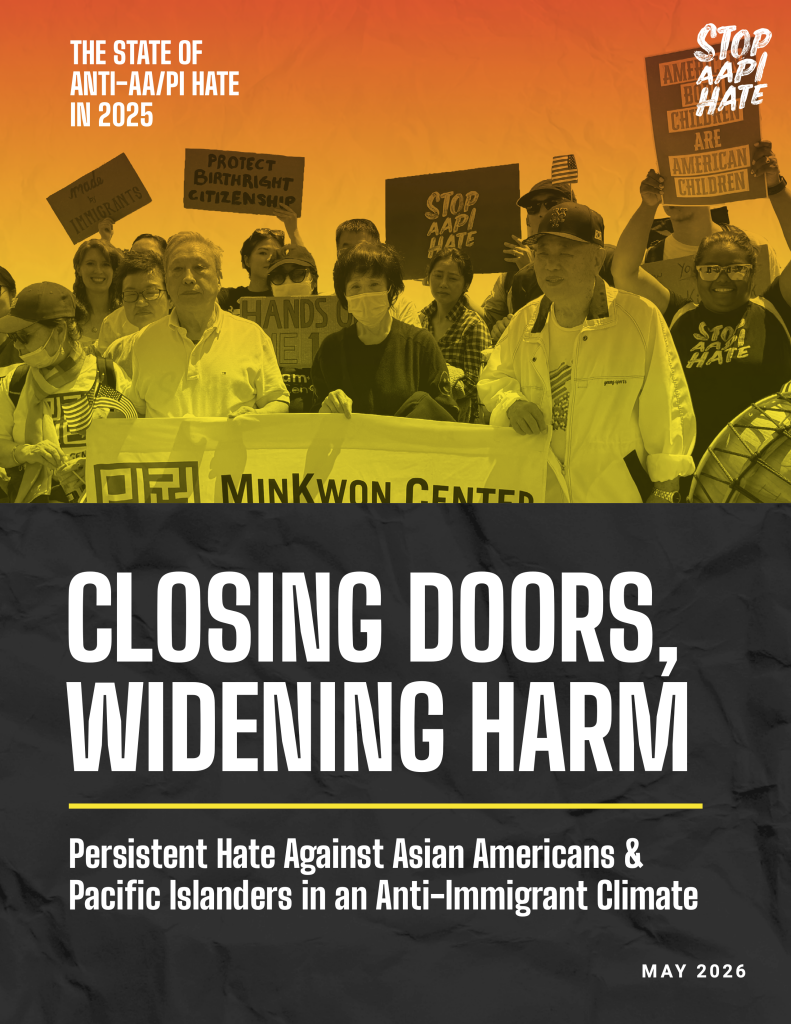
Anti-AA/PI hate remains alarmingly high amid Trump’s anti-immigrant policies and rhetoric.
Half of AA/PI adults experienced an act of hate in 2025, according to our third annual State of Anti-AA/PI Hate report. It’s an urgent reminder that racism and xenophobia did not end with the COVID-19 pandemic. And the anti-immigrant climate is adding new concerns.
Download Resources
Anti-AA/PI hate didn’t end with the COVID-19 pandemic; for half of AA/PI adults, it’s a fact of life.
During the COVID-19 pandemic, Asian Americans faced a dramatic surge in racism and xenophobia, as President Trump and other elected officials wrongfully accused them of spreading the virus. While the worst of the pandemic has come and gone, hate is still all too common. For three years now, Stop AAPI hate — in partnership with NORC at the University of Chicago — has conducted a national survey on the state of anti-Asian American and anti-Pacific Islander (anti-AA/PI) hate. And for three years, hate has persisted at staggering levels.
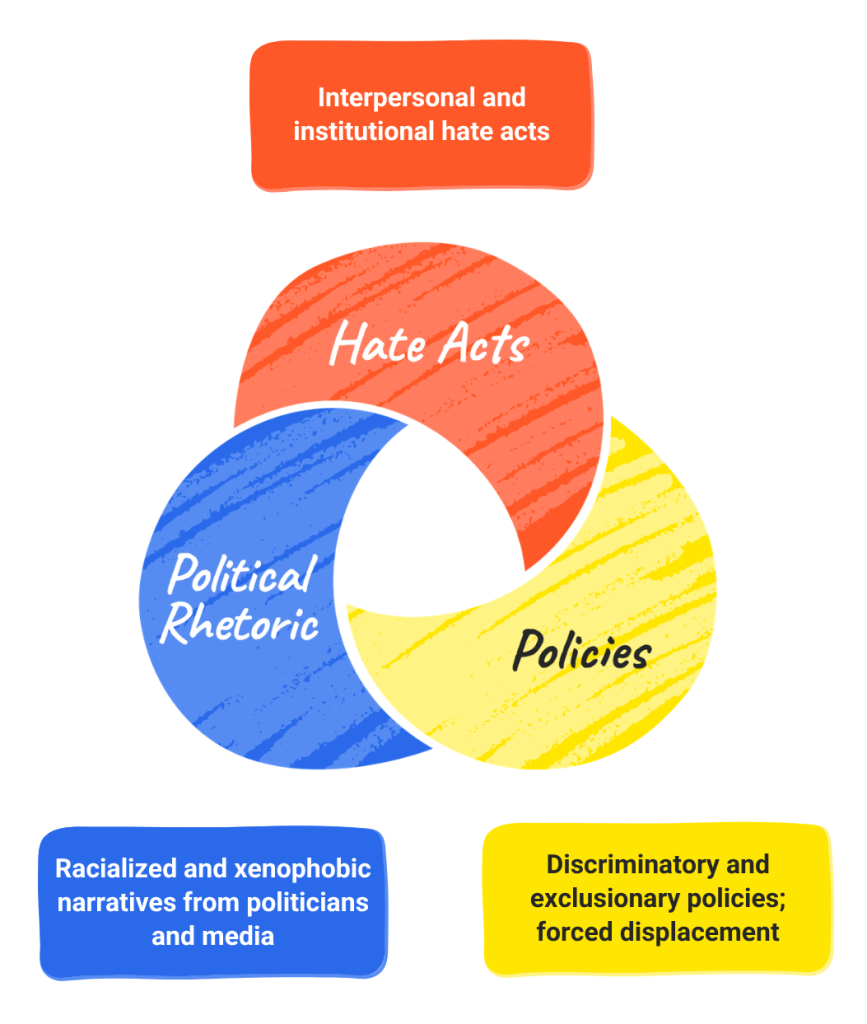
In 2025, half of AA/PI adults experienced an act of hate because of their race, ethnicity, or nationality — but the threat doesn’t stop there. Under the Trump administration, anti-immigrant policies, racist sentiment, and everyday acts of hate have started to feed into one another — creating a dangerous trifecta of anti-AA/PI hate that continues to close in on AA/PI communities from every direction.
Our report “Closing Doors, Widening Harm” brings together key findings from our national survey and first-hand accounts from the Stop AAPI Hate reporting center to capture the state of anti-AA/PI hate in 2025, including how it impacts different communities and what we can do to stop it.
Key findings
About half (49%) of AA/PI adults experienced a hate act in 2025 — a level that has held steady for three consecutive years.
- This is not an isolated problem. Levels remained consistent across age, gender, income, language, and ethnic subgroup.
- Harassment (44%) was the most common form of hate, followed by institutional discrimination (23%), physical harm (13%), property harm (10%).
- 43% of hate occurred online. Other frequently-cited locations include public spaces (40%) and businesses (36%).
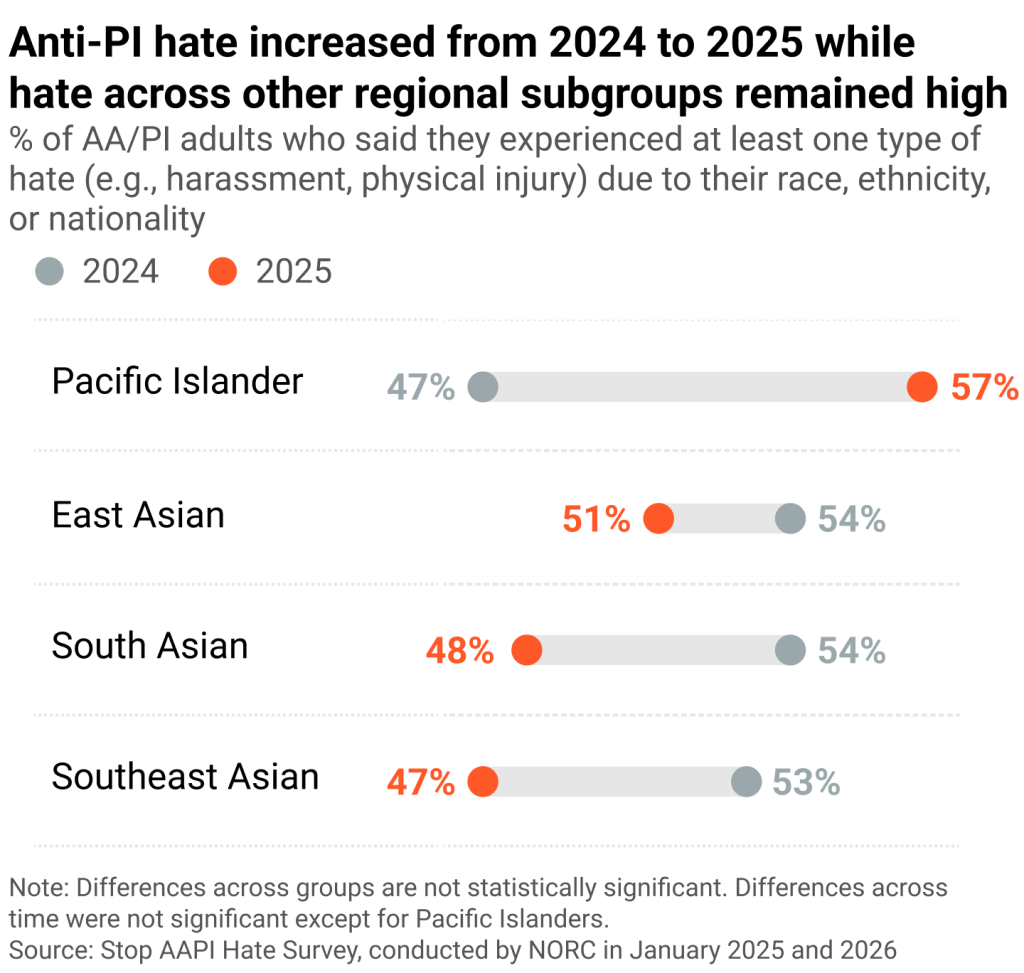
- Anti-Pacific Islander hate is on the rise — increasing from 47% in 2024 to 57% in 2025.
- Hate is intersectional. About half (52%) said they were targeted for at least one identity in addition to race. 27% said age; 25% said gender; and 23% said class.
53% of AA/PI adults said they — or an AA/PI person they knew personally — were harmed by anti-immigrant policies or sentiment.
- Many respondents felt anxious, afraid, and uncertain about their future: 36% said they — or someone they knew — had their immigration or citizenship status questioned or revoked, or feared it might be. 30% experienced or feared detention or deportation, and 28% considered leaving the U.S. or prepared to do so.
- U.S. citizens and non-citizens experienced similar levels of impact, as did U.S. born and foreign born AA/PI respondents.
Some guy posted that I should be locked up in concrete and do tricks…This person then proceeded to post that they are reporting me to ICE (I’m a citizen), and I should get my papers ready. Is this 1930s Germany?
– Multiracial Pacific Islander man
A “TRIFECTA OF HATE”
Anti-AA/PI hate doesn’t happen in a vacuum. Policies, political rhetoric, and everyday acts of hate work in coordination together, forming a self-reinforcing “trifecta of hate.” Here’s how it works:
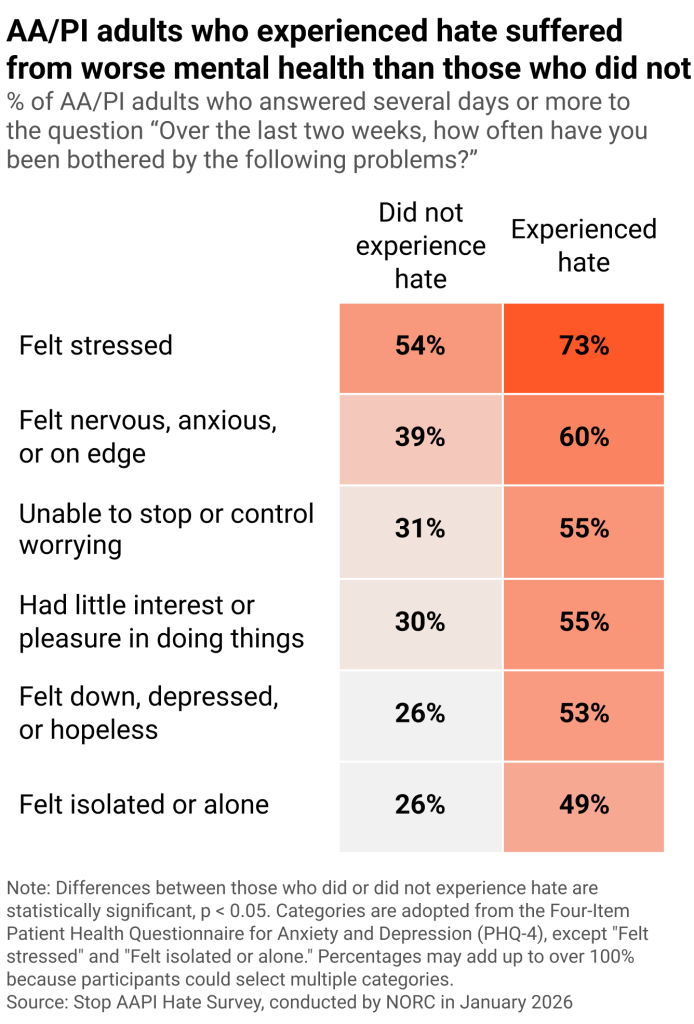
Hate continued to impact AA/PI adults’ mental health, with those who experienced hate in 2025 reporting worse mental health than those who did not experience hate.
- 73% of AA/PI adults who experienced hate reported feeling stressed, compared to 54% of those who didn’t.
- 49% of AA/PI adults who experienced hate reported feeling isolated or alone, compared to the 26% of those who didn’t.
- 25% of AA/PI adults who experienced hate exhibited moderate or severe symptoms of anxiety or depression, compared to the 10% of those who did not.
Of those who experienced hate, few of them reported it — and even fewer received adequate support.
- After experiencing a hate act, only around half (54%) of AA/PI adults shared their experience with anyone.
- Of those who experienced hate, just 22% reported to a formal authority or agency (e.g., a human resources department, school staff, the police, or a civil rights agency).
- Only one-third (33%) received any support at all and nearly half (48%) said at least one form of the support they received fell short of what they needed.
An individual called my son’s group of friends ʻch-ng ch-ngsʼ and ʻn-gg-s.ʼ My son told him to stop and leave them alone. The kid grabbed my son’s head and took his hat. My son reported [to the school], and it is not being taken seriously.
– Father of Southeast Asian boy in Washington
AA/PI adults were motivated to take action against racial discrimination — even as participation in resistance activities declined.
- 67% of respondents said they felt motivated to take action in 2026.
- However, 56% of AA/PI adults participated in activities to reduce or resist racial discrimination — down from 74% in 2023 and 66% in 2024.
We are able to continue publishing research like this because of the generous support of people like you.
Your donation to Stop AAPI Hate helps us conduct research and analysis on AA/PI communities — and sustains our fight to build a fairer, more equitable future for all.
Learn More
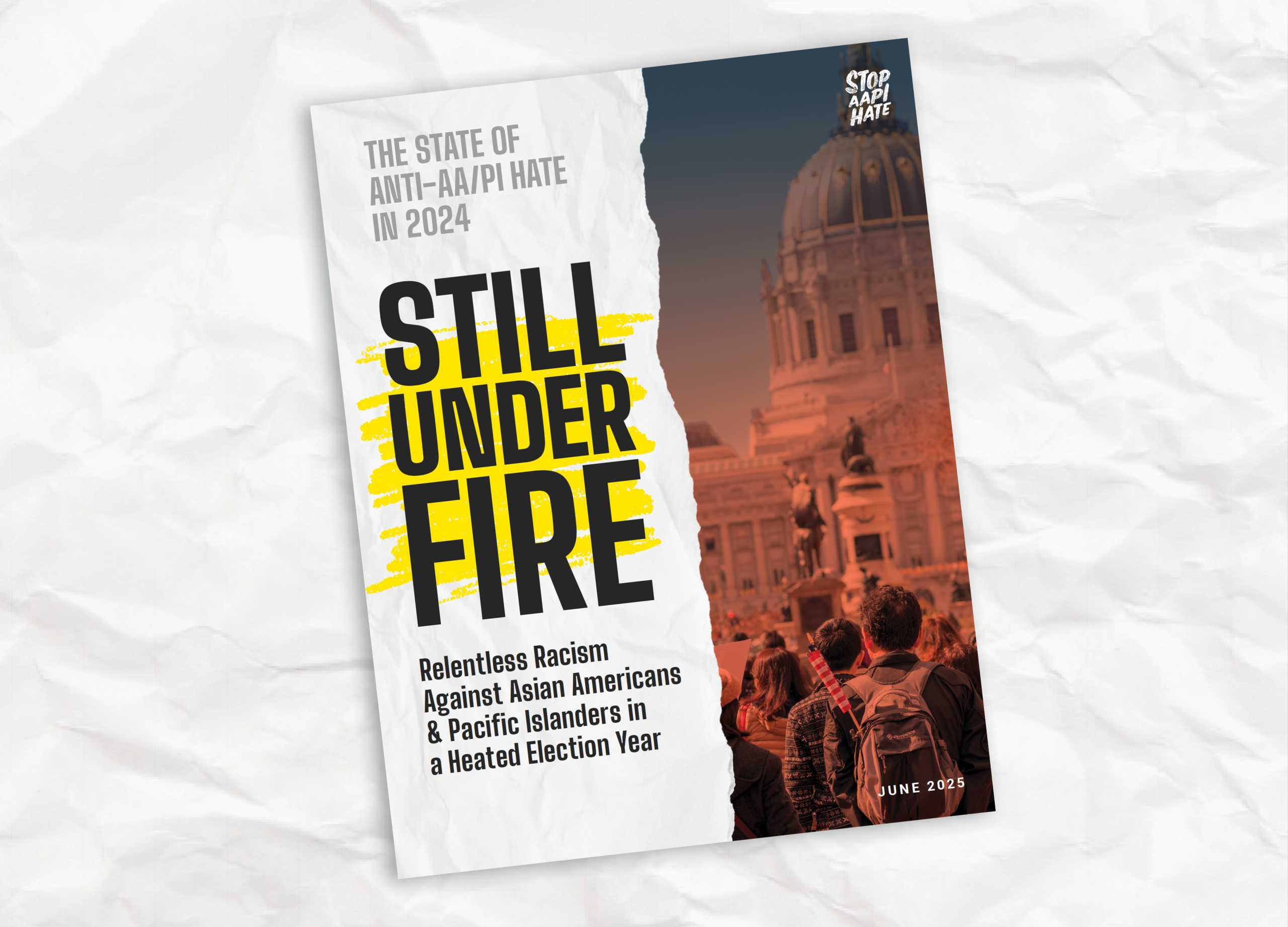
State of Anti-AA/PI Hate Report (2024)
Our second annual State of Hate report paints a sobering picture of widespread and persistent anti-AA/PI hate in 2024.

Report Anti-AA/PI Hate
If you see or experience an act of anti-AA/PI hate, take five minutes and submit a confidential report.
