
If you’re having a hard time following the latest U.S. immigration news, you’re not alone. Since he returned to office in January 2025, Trump has rolled out dozens of executive orders and directives to villainize, intimidate, and suppress the speech of international students and immigrant workers alike.
To make things even more complicated, some of his proposed changes are caught up in the courts. Others have been rolled back. At the same time, misinformation and disinformation have made it even harder for immigrant communities to keep up with all the policy changes.
To get the answers that people are looking for, we connected with experts at Chinese for Affirmative Action — a founding organization of Stop AAPI Hate — and the law firm Minami Tamaki during a recent San Francisco event. Keep reading for the information, resources, and calls to action they left us with.
Disclaimer: Stop AAPI Hate is not a legal services organization, and the information provided in this document should not be construed as legal advice. The information provided here is for informational purposes only. If you have specific questions about the immigration risks you or your family may face, please consult a qualified immigration attorney. To find immigration legal resources near you, check out the National Immigration Legal Services Directory.
The difference between “Visa” versus “Status”
First things first: what is the difference between “visa” and “status?” The two terms are often used interchangeably.
Your visa is the foil or sticker placed in your passport by a U.S. consulate outside the U.S., granting you permission to travel to the U.S. and seek entry. You can find it inside your passport. See Figure 1 for details.
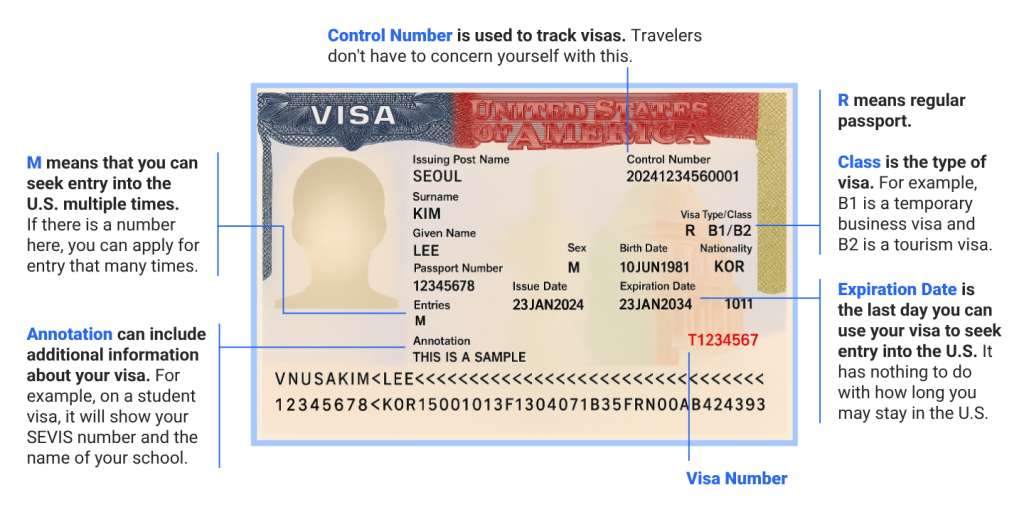
On the other hand, your immigration status (e.g., B-1/B-2, F-1, or H-1B) describes how long in the specific status you can lawfully remain in the U.S. Your immigration status is decided at the border, when you seek entry into the U.S., and is recorded on an I-94 (i.e., the Arrival/Departure Form), and you are able to seek an extension of your immigration status in the U.S. or change your status in the U.S.
Your visa can expire even if immigration status remains active. The reverse is also true: your immigration status can expire even if your visa remains active. In either case, you can face legal consequences — which means renewing your visa and respecting the rules of your immigration status is critical should you wish to remain in the U.S.
H-1B Visa Holders
There are an estimated 730,000 H-1B visa holders living in the U.S. Most of them are from Asian countries. In fact, Asian workers accounted for almost 90% of approved H-1B visa applications in 2024, with most applications coming from India (71%) and China (12%). However, recent changes could put the future of the H-1B program into question. Here’s what we know:
$100,000 fine on H-1B applicants and visa holders
The Trump White House announced a $100,000 fee for individuals filing first-time H-1B petitions on or after September 21, 2025, and who are not currently in the United States. This fee will not apply to those who submitted their H-1B petitions before September 21; those with a valid H-1B visa (travel in and out of the U.S. is still permitted); and those in H-1B status inside the U.S. who petition for amendment, change, or extension and are granted such amendment, change, or extension.
There is an exception to the $100,000 fee for individuals whose “presence in the United States as a H-1B worker is in the national interest” — but it’s up to the Department of Homeland Security to decide who satisfies this “high threshold.”
In short, the $100,000 fee targets H-1B applications from people who:
- Are outside the U.S. and who do not hold a valid H-1B visa.
- Are in the United States with a request for consular notification, port of entry notification, or pre-flight inspection.
- Are in the United States with a request for amendment, change, or extension of H-1B status, and that request is denied.
What else you should know:
- Petitioners should submit the required $100,000 payment using pay.gov according to the instructions available here. Petitioners must complete payment prior to filing a petition with USCIS and will be required to submit proof of payment from pay.gov — or proof of an exception from the Secretary of Homeland Security — in order to complete the filing process. Without proof of payment or proof of an exception, petitions subject to the $100,000 fee will be denied. Talk to an immigration attorney if you have questions about the payment.
- Trump has instructed the State Department to warn B-1 and B-2 visa holders against misusing their current status to avoid the $100,000 fine. We are still waiting for more specific guidance — but in the meantime, B-1 and B-2 visa holders who anticipate filing an H-1B application should consult legal counsel.
KEY WORDS
Cap-exempt visa: In the H-1B program, a cap-exempt visa is a work visa that does not count towards the federal quota (“cap”) of 65,000 annual H-1B admissions.
H-4 dependent: This status allows the spouse and unmarried children under 21 of H-1B visa holders to follow them into the U.S.
📝 The American Immigration Lawyers’ Association has a helpful fact sheet with even more information about the new fine.
Proposed changes to the H-1B lottery system
On September 24, 2025, the Department of Homeland Security announced plans to replace the current H-1B lottery system for H-1B cap-subject petitions with a weighted selection process, prioritizing higher-paid foreign workers. Here’s what we know:
Under the new system, each H-1B petition will be assigned to one of four wage levels, and each wage level will be given a specific number of entries into the selection pool. As a result, high-wage earners (Level 4) will be four times as likely to receive an H-1B visa in comparison to low-wage earners (Level 1).
➡️ Where do you fit in? To make a determination, the Department of Labor will look at your occupation, position requirements, and geographic location.
Please note: This is just a proposal and it still has to go through a one-month commenting period before the Trump administration makes a final decision. This could take months.
What can we expect in the coming months?
Under the Trump administration, it appears that the future of the $100,000 H-1B fee will be decided in the courts. In recent days, a national coalition of labor unions and immigrant justice organizations filed the first legal challenge to Trump’s proclamation. Not long afterwards, the U.S. Chamber of Commerce announced a lawsuit of its own. Where does this leave immigrant workers? The answer is unclear, and it could take months before a final decision is reached.
International Students
Trump’s anti-immigration political agenda extends well beyond H-1B workers. For months, international students have found themselves caught in the crossfire. Most of all, Asian students, who account for over 88% of the international students pursuing higher education in the U.S. So far, the administration has relied on two main strategies: visa revocations and status terminations.
In March 2025, Secretary of State Marco Rubio revoked 300 F-1 (student) visas from international students — making it impossible for them to travel or re-enter the U.S. At the same time, ICE terminated the immigration status (i.e., SEVIS records) of F-1 visa holders nationwide — robbing thousands of international students of their right to work, travel, and even attend classes.
Since then, the administration has grown more and more aggressive — revoking at least 6,000 FMJ visas and terminating at least 4,700 SEVIS records in 2025 on questionable allegations of “criminal conduct” or “support for terrorism.”
Some students have even had their visas revoked over fishing citations and speeding tickets. Others have lost their visas after protesting in support of Palestine or donating to Palestinian causes.
For international students, the path forward is uncertain. Those who have lost their status are forced to transfer schools and leave the country. Those who have lost their visas are effectively trapped in the U.S. — unable to return home for weddings, funerals, or cultural holidays without giving up their studies.

What about federal litigation? Students and immigration advocates filed more than 100 legal challenges against the Trump administration in response to its SEVIS termination policy. Many of them are still in process. Others have granted at least temporary relief to affected students.
All of this appears to have made a difference. In April 2025, ICE declared that it will cease the terminations of SEVIS records. Just a few weeks later, a federal district court judge in the Northern District of California issued a nationwide preliminary injunction, putting a stop to ICE’s arbitrary termination of the SEVIS records and calling for the restoration of all SEVIS records.
Continuous vetting and consular review
The Trump administration has also expanded screening and vetting for visa applicants. infrastructure for monitoring international students and other visa-holders.
The process is even more intensive for F-1 visa applicants. Starting on June 18, 2025, all FMJ applicants are expected to make their social media accounts public, to allow consular officers to review your entire online presence. Should you refuse, officials could reject your visa application on the grounds of “evasiveness.”
Other important considerations
Trump’s travel ban on 19 countries — including four Asian and Pacific Island nations — restricts people from around the world from traveling to the U.S. for business, tourism, or even tourism. Though it doesn’t revoke visas from current students, it does stop their families from visiting and attending their graduation ceremonies.
Secretary Rubio has announced plans to enhance screening for F-1 visa applicants from China or Hong Kong and revoke visas from Chinese students who are either connected to the Chinese Communist Party or majoring in “critical fields.” For the hundreds of thousands of Chinese international students at U.S. colleges and universities, the implications are profound.
ℹ️ What do Trump’s travel restrictions and screening policies mean for your travel plans? Read our blog post to find out.
A new proposal from Secretary Noem replaces F-1 “duration of status” — which lets international students remain in the U.S. so long as they are in school — with a “fixed period of stay” (e.g., four years). For students who change programs, or whose studies take longer than anticipated, this means leaving the country or going through the application process for a second time.
💡 Stop AAPI Hate submitted a public comment in opposition to this proposal for placing undue burden on international students.
Another proposal limits “third-country national” (TCN) visa processing, which allows international students to renew their visas in a country that isn’t their home country. Now, students will have to return to their home countries, which can be far more expensive and time-consuming than traveling to Canada or Mexico, for example. And for students from countries with long visa processing times or political conflict, this will make it even harder to continue their U.S. studies.
Impact on international students
Decline in international student enrollment
Understandably, aggressive new policies targeting F-1 and H-1B visa holders have fueled a dramatic decline in international student enrollment this fall. 20% fewer international students (and 70% fewer Asian international students) travelled to the U.S. in August, according to the New York Times.
Another factor: a massive workforce reduction at global consular offices, leading to scheduling backlogs and long processing times.
Increase of visa denials
Visa rejection rates for Indian immigrants are at a ten-year high, according to immigration experts. In August 2025, at least four Indian students came forward after their student visa applications were denied. The provided explanation: insufficient ties to India, where all of them were born and raised.
Suppression of speech
Following Trump’s crackdown on higher education, dozens of student activists — many of them international students — have been targeted with ICE detention or deportation. As a result, more and more international students at U.S. colleges and universities have turned to “self-censorship” in order to protect their status.
Some students report scrubbing their social media profiles or removing their names from political op-eds. Others have changed their walking routes to avoid “free speech zones” or disengaged from on-campus activism.
In September 2025, a federal judge in Massachusetts called out the Trump administration for violating the first amendment by systematically targeting pro-Palestinian students as means to spread fear on suppress free speech on campus.
This is promising news — but for international students, it does little to assuage their fears of detention or deportation.

Resources
Still have questions? H-1B and student visa-holders in search of legal assistance or immigration updates — keep on reading for essential reading, know your rights, and resources.




Watch the Recording
Our friends at Chinese For Affirmative Action, and University of San Francisco organized an in-person event on recent changes to U.S. H-1B and student visa policies. This event was filmed in September 2025, and may contain information that is out of date. This recording is purely supplemental to the information above. Rules constantly change, please consult a reputable immigration attorney for information on your situation.

2025 Immigration Updates: Impact on Students and Workers
What Asian and Pacific Islander H-1B and student visa holders need to know about recent changes to immigration policy.