

In 2025, the Trump administration reshaped and upended the lives of Asian and Pacific Islander people across the country. ICE agents are unlawfully abducting people and tearing families apart. Sudden immigration policy changes are leaving visa-holders in limbo and cutting off critical pathways to safety for asylum seekers and refugees. And high-ranking officials are spewing racist, xenophobic rhetoric that puts people of color in danger.
In this edition of Keeping Count, we’re breaking down five data trends that capture just a few of the urgent challenges our communities face — but also what we’re doing to fight back against injustice and keep each other safe.
ICE is ramping up arrests of Asian immigrants.
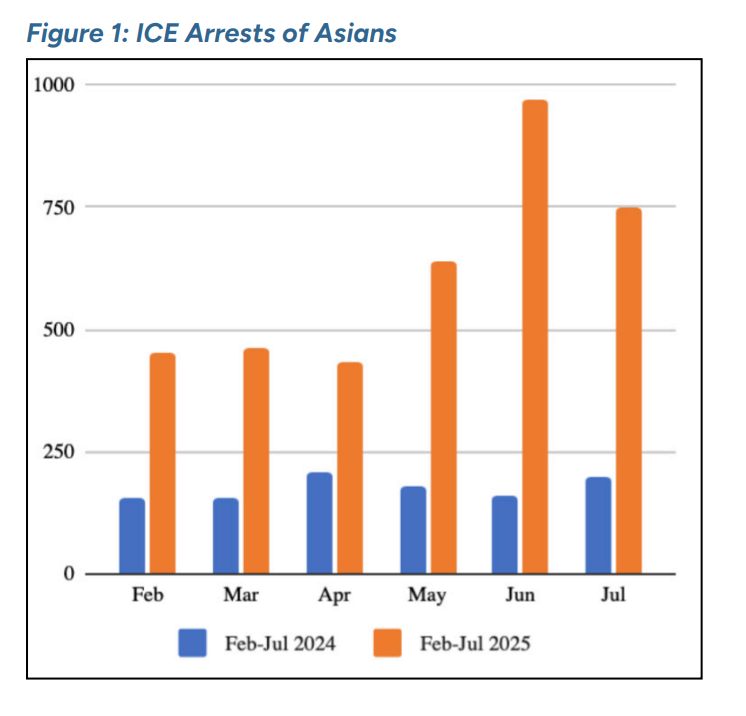
The number of Asian people arrested by ICE more than tripled since Trump took office, according to a report from UCLA, increasing from 1,054 during the February to July 2024 time period to 3,705 during the same months in 2025.
The top five Asian countries of origin for people arrested by ICE include China (30%), India (28%), Vietnam (15%), Laos (6%), and Nepal (3%).
Here’s what else we know: On average, the Trump administration is detaining more women and older people compared to the Biden administration. And contrary to the Trump administration’s false claims, the majority of Asian people detained by ICE have no criminal record. In fact, the number of detained people without a criminal record has more than tripled under the Trump administration.
International students are living in fear.
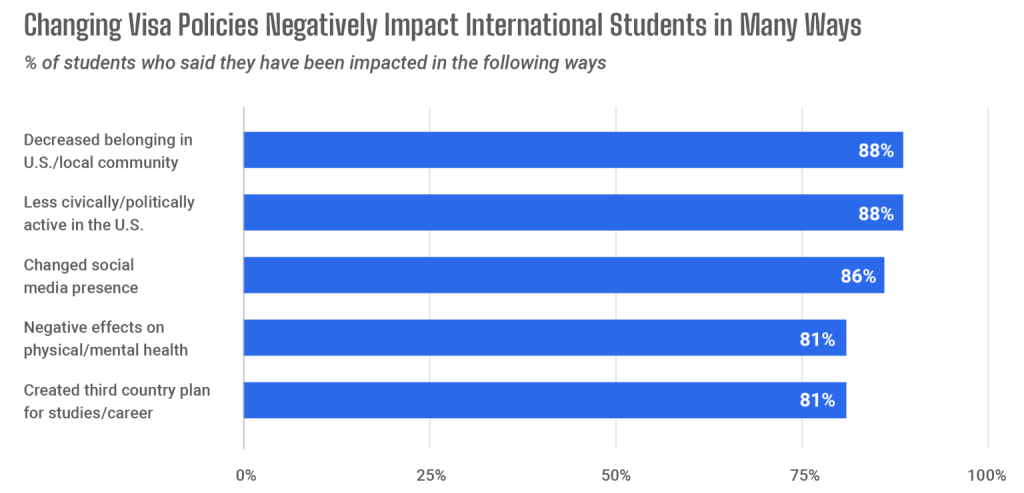
Just 4% of international students reported feeling “very” or “extremely” safe in the U.S. today, according to a national survey from Stop AAPI Hate.
Trump’s attacks on immigration, education, and free speech are taking a major toll on international students nationwide. In fact, many report feeling a decreased sense of belonging (88%), scaling back their political engagement (88%), or changing their social media presence (86%) as a result of anti-immigrant policies under Trump.
DID YOU KNOW? THE VAST MAJORITY OF INTERNATIONAL STUDENTS ARE FROM ASIAN COUNTRIES.
- Of the 1.2 million international students enrolled in U.S. colleges and universities, 72% are from Asian countries.
- The top countries of origin include India (which accounts for 31% of all international students), China (23%), and South Korea (4%).
As a result of rising hostility, international student enrollment is already starting to plummet. The number of international college students enrolling in American schools for the first time decreased by 17% this fall.
The number of new U.S. student visas has also declined across all Asian countries, except Indonesia. Notably, there was a 40% decrease in new student visas issued to people from India in 2025 — that’s 4,000 fewer visas than 2024.
Anti-South Asian and anti-Afghan hate spiked online.
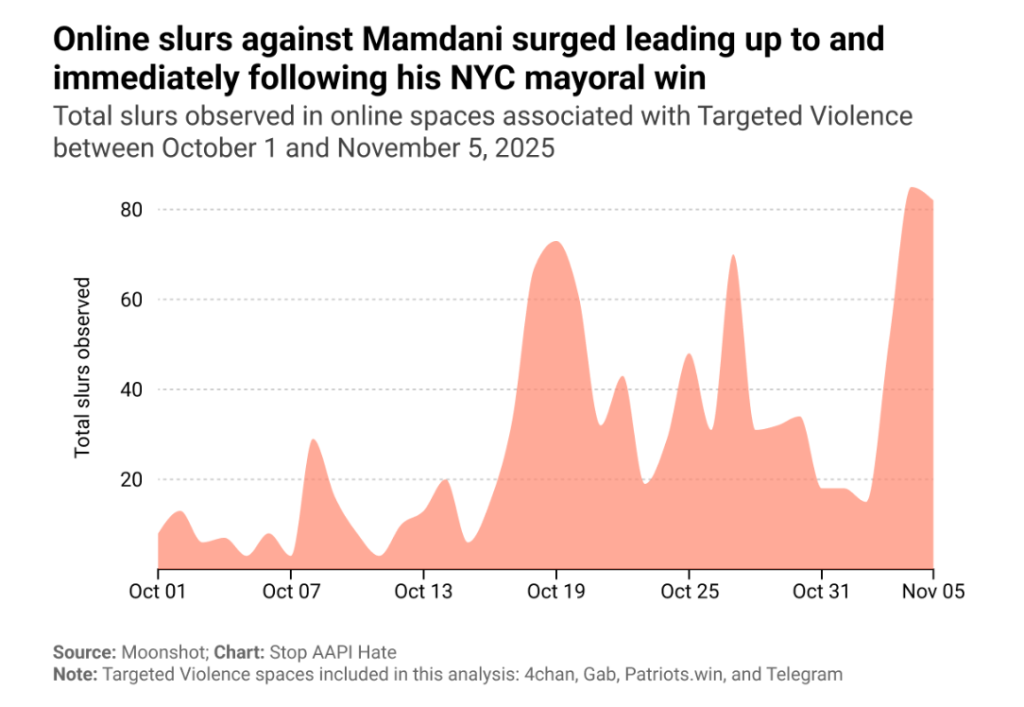
We also found that anti-Muslim slurs accounted for the vast majority of anti-Mamdani activity online. There was a 913% increase in Islamophobic slurs on November 5, the day after Election Day, compared to October 1, 2025.
Amid a broader rise of anti-Asian hate, New York City mayoral candidate Zohran Mamdani faced a 238% increase of anti-Muslim and anti-South Asian slurs at the height of election season between October 1 and November 11. That’s according to a recent data analysis from Stop AAPI Hate and Moonshot, a group that tracks hate in online spaces associated with targeted violence (e.g., Truth Social, Telegram, and 4chan).
Anti-Mamdani rhetoric also found its way onto more mainstream social media platforms like X. Between June 24 and October 31, backlash against Mamdani inspired 35,522 original Islamophobic and/or anti-immigrant posts on X, according to the Center for the Study of Organized Hate.
And on November 26, another wave of hate swept the nation after an Afghan immigrant shot two national guardsmen in Washington D.C. In the 24 hours after the shooting, Moonshot saw a 552% spike in threats targeting Afghan people in online communities associated with targeted violence, including a significant surge of violent threats.
Donald Trump is losing traction with AA/PI voters.
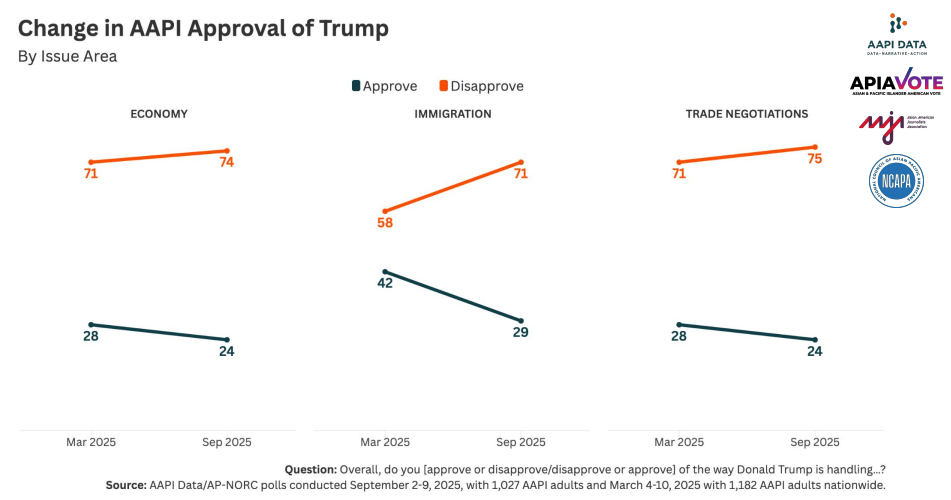
As of this September, 71% of AA/PI adults disapprove of Trump’s handling of immigration, according to an AAPI Data/AP-NORC poll. This is a 13-percentage point increase from March 2025, as Trump and his loyalists continue to dehumanize, detain, and deport immigrants — often without due process.
It’s not just immigration either. On issues like the U.S. economy and trade negotiations, a growing number of Asian Americans are souring on Trump.
Overall, Trump is losing support from AA/PI Republicans and Independents, while support from AA/PI Democrats has remained low.
Between December 2024 and October 2025, Trump’s disapproval rating rose from 16% to 26% among AA/PI Republicans; 44% to 68% among AA/PI Independents; and 89 to 93% among AA/PI Democrats.
Asian voters are turning out and taking action.
On election night, Asian voters turned out in strong numbers for Democratic candidates.
65% of Asian voters backed Zohran Mamdani in the New York City mayoral election. Support from South Asian voters was even higher at an overwhelming 87.2%.
We saw similar results in other states, where Asian voters strongly rejected Trump’s agenda. In the New Jersey governor’s race, Democrat Mikie Sherill won the support of 82% of Asian voters. And in Virginia, CNN’s exit polling reveals 80% of Asian Americans cast their ballots for Governor-Elect Abigail Spanberger.
In Virginia, Black and Asian voters were pivotal to Democrat Abigail Spanberger’s win for the governor’s seat. ➡️ 80% of Asian Americans cast their ballots for Spanberger, according to CNN's exit poll.
— Stop AAPI Hate (@stopaapihate.org) November 21, 2025 at 4:25 PM
[image or embed]
Implications
In the weeks and months ahead, we know attacks will continue to mount against Asian and Pacific Islander communities — including immigrants, citizens, international students, workers, families, children, and everyone in between.
But the numbers don’t lie: in the face of immigration raids, threats of violence, and federal cuts to education and healthcare, 2025 taught us that AA/PI communities are turning out to resist Trump’s racist agenda and make their voices heard at the ballot box, in the streets, and beyond.
We are able to continue publishing research like this because of the generous support of people like you.
Your donation to Stop AAPI Hate helps us conduct research and analysis on AA/PI communities — and sustains our fight to build a fairer, more equitable future for all.

Keeping Count | Five Ways Trump’s Agenda Impacted Asian Communities in 2025