


Learn how Asians and Pacific Islanders in the U.S. experience hate.
Stop AAPI Hate operates the largest reporting center dedicated to tracking acts of hate against Asian Americans (AAs) and Pacific Islanders (PIs) in the United States. When someone submits a report about their experience to us, our data and research team categorizes each act of hate according to our updated classification system. This allows us to extract patterns and themes that help paint a vivid picture of what hate looks like (e.g., verbal harassment or physical injury), where it happens, and who it affects (e.g., age, gender, etc.).
The following data visualization tool reflects our most up-to-date reporting center data and allows for custom analyses through the use of filters and other interactive functions. It is intended to support researchers, journalists, community organizations, and others interested in learning more about anti-AA and anti-PI hate.
Using our reporting center data
We encourage researchers, journalists, academics, community organizations, and others to leverage our data, as it offers critical clues about the various ways Asian American and Pacific Islander communities experience hate. However, there are important guidelines to follow when interpreting and/or using our data:
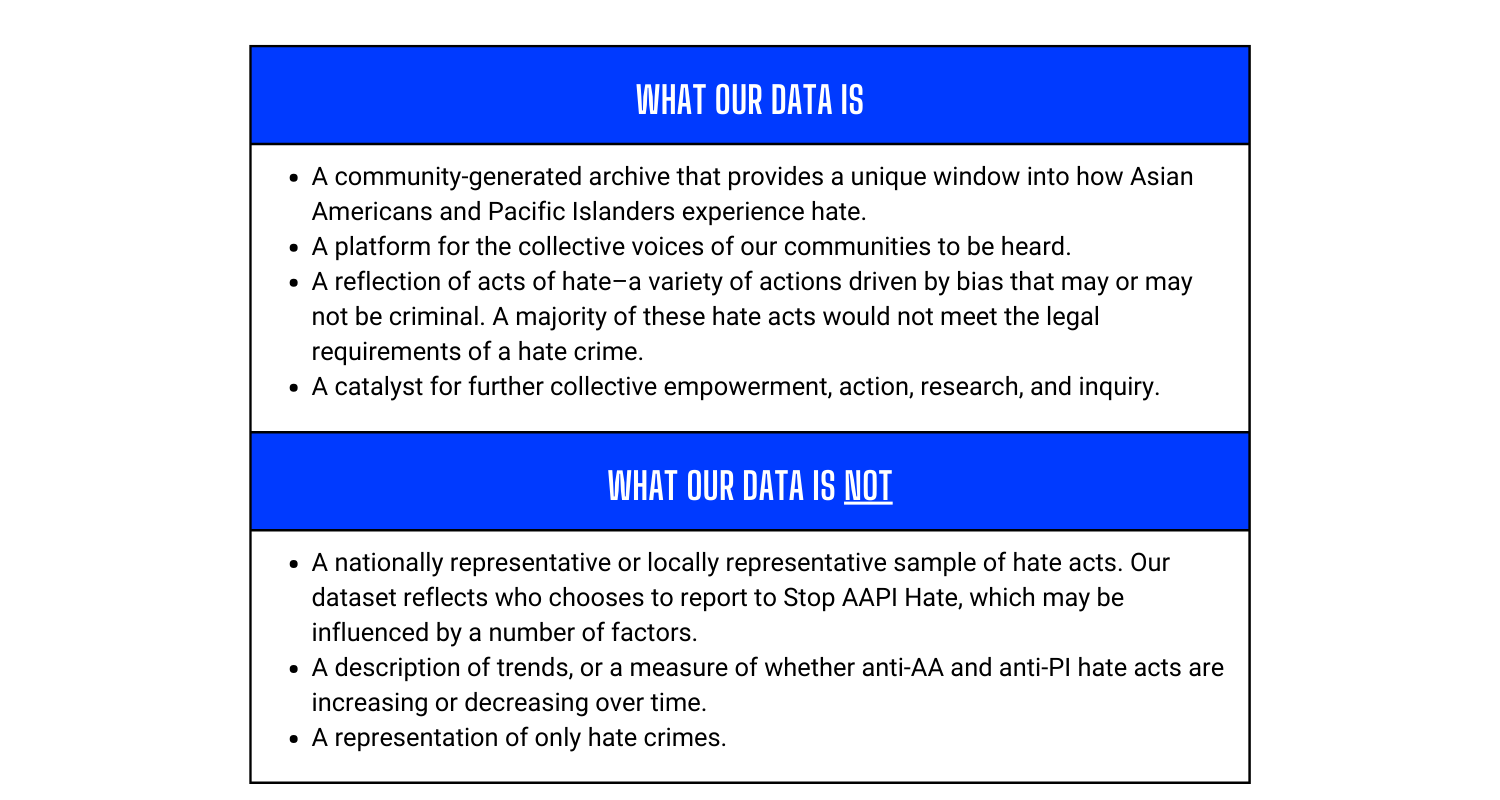
- Hate act numbers from our reporting center should not be used in isolation to represent the full prevalence of anti-Asian or anti-Pacific Islander hate at any given time. Like all datasets that rely on voluntarily submitted reports, our numbers are just the tip of the iceberg. For every act of hate that is reported, there are many more that go unreported. The volume of reports to Stop AAPI Hate is subject to numerous factors, including but not limited to: awareness of and access to the reporting center, current events that spur reporting, and reporting fatigue.
- We caution against making claims about hate crimes based on our data. For an act to constitute a hate crime, it must be formally investigated and declared so by law enforcement. Therefore, while a portion of the hate acts reported to us may constitute potential hate crimes, it would be inaccurate to describe our data as hate crime data since these cases may or may not have been reported to law enforcement and investigated. Further, the majority of hate acts that our communities experience are non-criminal acts.
FAQ About Our Tool
How should I cite this dashboard and the corresponding data?
When citing Stop AAPI Hate’s data and the following dashboards, please use the following citation:
Stop AAPI Hate. “Hate Act Data.” Accessed [date]. stopaapihate/org/explore-our-data
Can I access state- or county-level data?
To protect the privacy of individuals who choose to report to us, we share data disaggregated by state and county for areas with an AA/PI population of 20,000 or more. You can access data for these states and counties through our tool or by downloading the datasets above in Excel format.
How often will Stop AAPI Hate’s data visualization tool be updated? Are you still releasing data reports separately?
We update our data on an annual basis. An annual cadence allows us to carefully process each report as well as collect enough data to extract valuable analyses and insights. Our 2024 data will be available in the Spring/Summer of 2025.
Our data visualization tool is the primary way to access our reporting center data. Additionally, we release separate thematic reports based on our data or original studies, including surveys. One example of a thematic report is “The Blame Game: How Political Rhetoric Inflames Anti-Asian Scapegoating (2022)”, which examines how AA/PI communities are scapegoated for public health, national security, and economic problems.
What if this data tool does not meet my needs?
You may request custom data by filling out this form. We are able to share:
- summary statistics (not raw data or data on each individual report)
- for any geography with an AA/PI population of 20,000 or more
- for a period of 12 months or longer
FAQ About Our Data
Why does Stop AAPI Hate report on acts of hate and not just hate crimes?
Stop AAPI Hate reports on a wide range of hate acts (actions driven by bias against one or more personal characteristics including race, gender, or sexual orientation). Some hate acts are potential hate crimes (or bias-motivated criminal offenses), but the majority of hate acts are non-criminal behaviors that contribute to a hostile environment.
These include verbal harassment, including the use of racial slurs, and unfair treatment, including refusal of service or inferior service by a business. Many formal federal and state datasets only capture hate crimes. By reporting on the broader category of hate acts, Stop AAPI Hate is able to shed light on the non-criminal acts of hate that comprise the majority of hate that Asian American and Pacific Islander communities face in everyday life.
Why aren’t you tracking the ethnicity or race of offenders?
We choose to center the experiences of those harmed. We do not track the ethnicity or race of offenders, as it is not necessarily conducive to the implementation of effective solutions and can be misused and misconstrued to fuel hate against other groups of people. Focusing on demographic characteristics contributes to unjust profiling and punitive measures rather than holistic and preventative solutions that address the root causes of hate and lead to safer communities.
Rather, we track the position of the offender – whether it’s an individual or institutional representative – which allows us to create tailored, effective solutions. Institutional discrimination requires improvement in institutional policies and practices, and possibilities for civil rights protections, rather than solutions rooted in the criminal legal system.
How is Stop AAPI Hate’s data different from other sources of data on anti-Asian or anti-Pacific Islander hate?
There are many different ways to examine and understand racism and hate. You can look at nationally-representative surveys, like our survey with NORC at the University of Chicago. You can look at FBI reports that solely look at hate crimes. You can look at academic papers or data from other community-driven reporting centers like ours. No single dataset in isolation can paint the whole picture — but each provides important clues about the state of hate.
Stop AAPI Hate’s data is unique and valuable because we examine a wider range of hate acts – not just hate crimes. This allows us to understand the full breadth of our communities’ experiences with hate, which is important because not all acts of racism and discrimination are explicit hate crimes.
In addition to collecting general information from those who report to us, we also allow them to share their experiences with hate in their own words. The written descriptions we receive enable us to better understand hate acts and their impact on a more nuanced level. Publicly sharing these stories, when consent has been given, helps to humanize the issue and more vividly illustrate the harm.
Download Resources
Learn More

Shades of Hate Report
Learn how we categorize different acts of hate to get insight into the full spectrum of racism and discrimination AAPI communities face.

2023 State of Hate Report
Learn how AA/PIs experience hate, the impact on AA/PI victims, and key motivators for political activation and civic engagement.