



In January, a Hmong American person from Minnesota submitted a chilling report to Stop AAPI Hate: “ICE [is] going door to door in Minneapolis trying to get neighbors to report where Hmong people are living […] ICE agents are asking [them] to report any Asians in the neighborhood.”
Similar reports have surfaced online, confirming that ICE and DHS in Minnesota are targeting Hmong people: staking out Hmong businesses, patrolling immigrant-rich neighborhoods, and terrorizing families that have called America home for decades.
What is happening to Minnesota’s Hmong families reveals the racism underpinning Trump’s anti-immigrant operation. It also signals what could lie ahead for other Asian communities nationwide.
That’s why in this edition of Keeping Count, we’re shedding light on who Hmong Americans are, the roots of their resettlement in Minnesota, and the ways in which local communities continue to resist federal attacks on their rights and their livelihoods.
The origins of Hmong America
The Hmong people are an ethnic group from multiple countries in Southeast Asia, including Cambodia, Laos, Myanmar, and Vietnam. Most Hmong Americans, however, trace their roots back to Laos. Why? Because of the CIA.
During the Cold War, the CIA recruited Hmong people in Laos to support U.S. efforts to stop the spread of communism in Southeast Asia. 30,000-40,000 Hmong soldiers were killed in combat during the so-called “Secret War” (1964-1973), and an estimated one-quarter of Hmong men and boys died while fighting the communist Pathet Lao and the North Vietnamese Army.
Things changed after the Vietnam War when the Pathet Lao rose to power in Laos. The Pathet Lao began systematically targeting Hmong people for working with the U.S. government. Many Hmong people were imprisoned, persecuted, or killed, prompting thousands to flee.
And because of their direct involvement in the U.S.-led war in Laos, approximately 90% of Hmong refugees were allowed to resettle in the U.S.
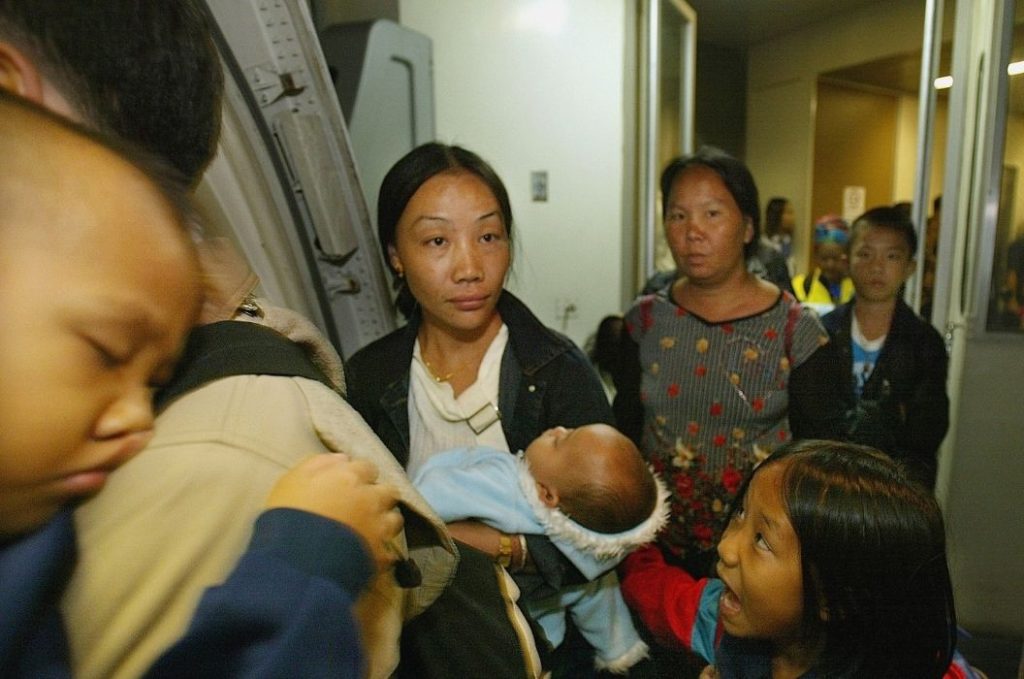
MINNESOTA: A PLACE OF REFUGE
Minnesota is one of the nation’s highest refugee-receiving states.
In addition to Hmong families from Laos, Karen families from Myanmar as well as Somali and Liberian families, have sought safety and built new lives in the Twin Cities in recent decades.
Refugee communities have borne the brunt of Trump’s anti-immigrant agenda. For example, the Trump administration recently ended deportation protections for Burmese immigrants — endangering the status of thousands of Karen people in Minnesota, who fled genocide in Myanmar. A federal judge has temporarily blocked the decision, but the future of Burmese immigrants is still uncertain.
The first wave of Hmong refugees arrived in the U.S. in the 1970s. The second followed ten years later thanks to the Refugee Act of 1980 and the third wave, in the 2000s. Today, an estimated 360,000 Hmong people live, work, and raise their families in the U.S., making them the 10th largest Asian ethnic group in America.
Minnesota alone is home to more than 95,000 Hmong people — with the vast majority (90,637) living in the Twin Cities of Minneapolis and St. Paul. In the Twin Cities, Asian people account for the largest proportion (37%) of the immigrant population. (Source: Stop AAPI Hate’s tabulation of 2019-2023 5-year American Community Survey via IPUMS)
Since the 1970s, local Hmong communities have established deep roots in the Twin Cities, starting families, opening businesses, and even running for public office. Today, most Hmong people are U.S. born. Of those who came here as immigrants, 90% have lived in the U.S. for over a decade and 85% are naturalized citizens.
But that hasn’t stopped DHS and ICE from turning their focus to Hmong people in Minnesota.
What’s happening in Minnesota?
In Minnesota, Hmong families remain on high alert as ICE and DHS agents continue to stalk, harass, and kidnap immigrants and people of color. In addition to going door-to-door, they have been following people on their way to work or school, making people terrified to leave their homes. Even more alarming: when people have asserted their legal right to refuse to open the door without a judicial warrant, agents have sent deceitful letters luring them to appear at their local ICE office and then detaining them on arrival.
As a result, fear of racial profiling has spread like wildfire across Hmong communities in St. Paul and Minneapolis — even among U.S. citizens. One family recalls sheltering in place after a watchful neighbor warned them ICE was close by. “It was something out of a horror movie,” they said.
Their fears are not unfounded. In a matter of weeks, dozens of Hmong people in St. Paul and Minneapolis have been targeted at home, work, and beyond — including at least one U.S. citizen who was dragged out of his home barely clothed into freezing temperatures.
So, what is behind such vicious attacks on Minnesota’s Hmong communities? There are several reasons for this.
1. Operation PARRIS: On January 6, 2026, Trump launched Operation PARRIS — short for “Post-Admission Refugee Reverification and Integrity Strengthening.” Under this controversial DHS program, ICE is targeting 5,600 Minnesota refugees — including many Hmong people — without permanent resident status. Now, thousands of pre-vetted immigrants who are here lawfully are in danger of being arrested, detained, and transferred out of state without due process or access to legal assistance.
- Case and point → Thi Dua Vang fled religious persecution in Vietnam, arriving in St. Paul two years ago with legal status. ICE agents still put her in handcuffs and transported her to a detention center in Texas. Even after a federal judge ordered her release, ICE has continued to return to her home. Afraid of what could happen outside of the house, Thi has since put her son into online school.
2. Crimmigration: In addition to targeting refugees, ICE and DHS are also training their focus on Hmong people with past records — even though many got into trouble with the law when they were just teenagers and have already served their time. This form of double punishment is a prime example of the crimmigration pipeline, which has a disproportionate impact on Southeast Asian people. It also goes against our constitutional values.
- Case and point → Local activist Thao Xiong was volunteering at a food bank when ICE agents put him into handcuffs — even after he showed them his documentation. Since serving time in 2016, he has spent the past 10 years turning his life around and giving back to the community.
3. Racial profiling: In Minnesota, ICE and DHS are targeting and arresting people simply based on what they look like and how they talk. This racist approach has resulted in immigrants being detained and deported without due process and has even caused U.S. citizens and lawful residents to be illegally arrested.
- Case and point → Chongly Scott Thao, a Hmong grandfather and U.S. citizen from St. Paul, was forcibly removed from his home in freezing cold weather, wearing just his underwear and a pair of sandals. ICE held him for questioning for over an hour, despite his daughter-in-law’s best efforts to show them his identification.
The impact of Trump’s anti-immigrant attacks
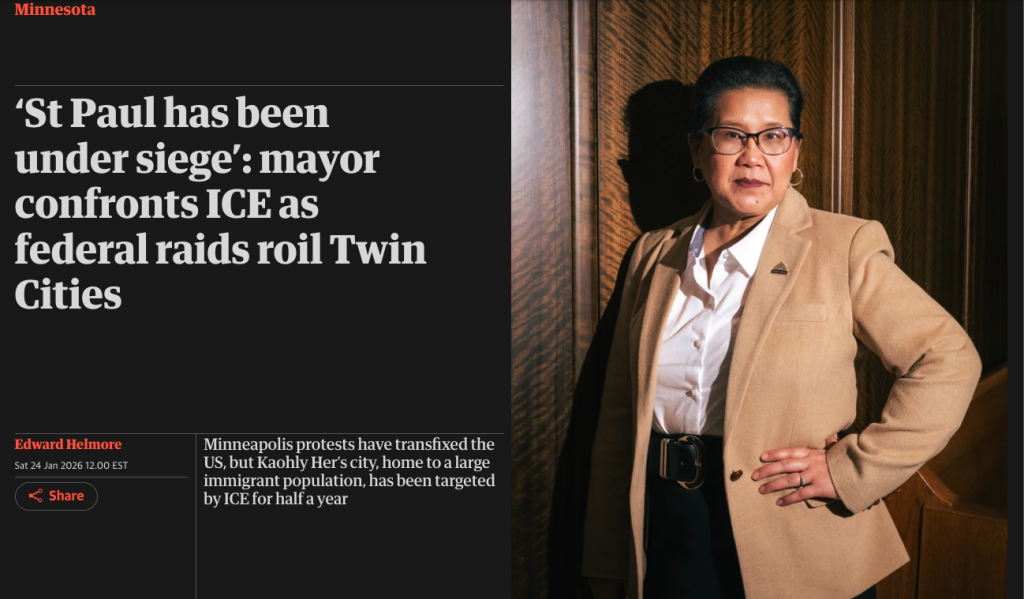
St. Paul mayor Kaohly Her in an interview with the Guardian shares what’s happening on the ground in her community.
The impact on local Hmong communities is substantial. Kaohly Her, St. Paul’s first Hmong American Mayor says the fear of racial profiling and unjust detention has created a chilling effect. Hmong families are afraid to leave their homes for any reason. At the Hmong Village Shopping Center, usually bustling with local shoppers, business is down 60-70%. Students are afraid to go to school, concerned that their parents will never come home again.
Meanwhile, immigrants in ICE detention recount severe abuse and neglect, like being shackled at the wrists and ankles and shuttled from one detention center to another with limited access to communication with their families or lawyers. One Hmong American woman — a green-card holder who had lived in the U.S. for close to 40 years — says she didn’t know her rights because no one explained them to her.
Deportation can be even more traumatizing. Not to mention, it can be a complicated process for Hmong people with roots in Laos.
This is because if you are a) a non-U.S. citizen and b) Laos was your country of origin or last place or residence, then U.S. immigration authorities will treat you as a Lao national for removal purposes and seek to deport you to Laos. It doesn’t make a difference that Hmong people are a part of a stateless ethnic group and still face extreme persecution in Laos.
Immigrants deported to Laos then face an impossible choice: to remain behind bars in a Lao prison or face homelessness, exploitation, human trafficking, or worse — all without the support network they had in the United States.
Hmong immigrants from Laos, Cambodia, and Vietnam have long struggled with the intergenerational trauma of war, statelessness, and displacement. The kind of systematic targeting they face under the Trump administration can be retraumatizing.
“It reminded me of what I went through in Vietnam. It’s going to be a couple of long years because of the president and his policies, and I’m waiting for the time to feel free again,” said Thi Dua Vang, recalling the time she spent in ICE detention.
As a result of recent inhumane policy changes, an untold number of Southeast Asian immigrants, including Hmong people, have been ripped from their families, detained in inhumane conditions, and deported back to countries they may have left as children — or in some cases, never lived in at all. And Hmong communities are terrified that number will continue to grow.
The emerging resistance
What’s happening in the Twin Cities is a canary in a coal mine for Asian people across the United States. Today, it’s the racial profiling and systematic targeting of Hmong people — but as ICE and DHS ramp up immigrant surveillance, it could just as easily be another ethnic group tomorrow.
ICE arrests of Asian people have tripled since Trump took office in 2025. The Trump regime also continues to attack lawful pathways that Asian people have long relied on to live, work, and raise families in America. This includes ongoing attacks on international students, H-1B workers, and visa applicants. And Trump’s executive order to ban birthright citizenship threatens to not only leave thousands of U.S.-born children stateless and without rights, but also slash the size and political power of the Asian American community for generations to come.
Trump’s anti-immigrant agenda has also fueled racism and anti-immigrant hate against Asian communities, regardless of status or citizenship. In recent months, a Asian American child in Texas left a soccer game in tears after another player called him an “illegal immigrant.” And after New York elected its first Muslim and Asian American Mayor, federal elected officials called for his deportation.
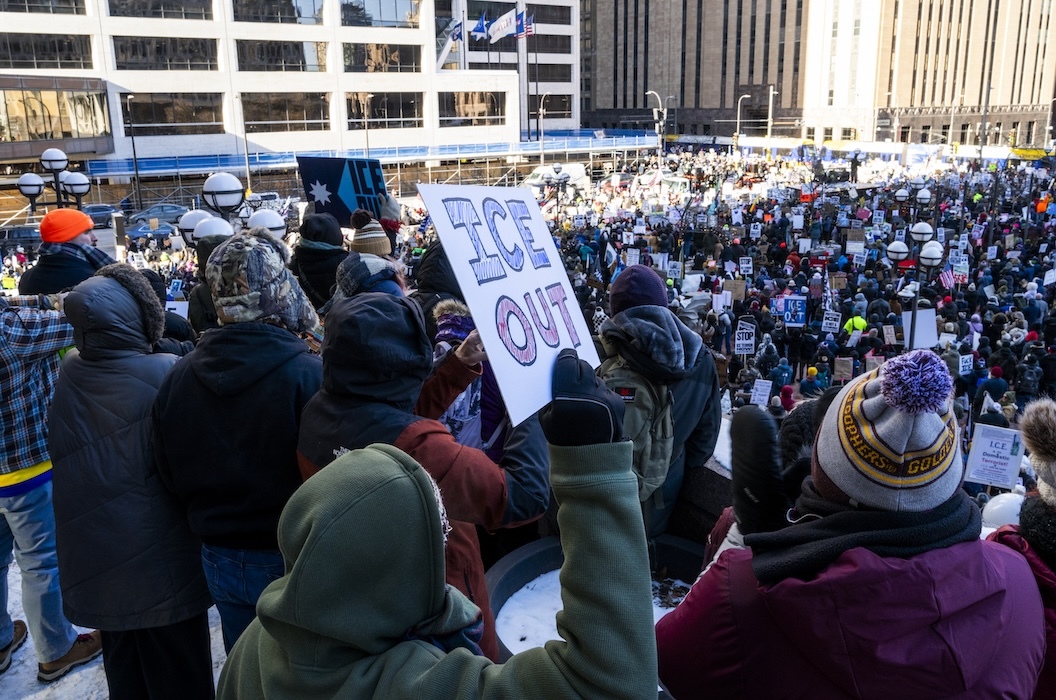
Protestors rally as part of a “Nationwide Shutdown” demonstration against ICE enforcement on January 30, 2026 in Minneapolis, Minnesota. Protests continue calling for an end to immigration raids in the Twin Cities which have already resulted in the deaths of Alex Pretti, a 37-year-old ICU nurse at a VA medical center who died January 24, after being shot multiple times during a brief altercation with border patrol agents, and Renee Good a 37-year-old mother of three children who was killed by ICE agents on January 7th. (Photo by Stephen Maturen/Getty Images)
But amid all the devastation, we’re seeing growing resistance. Asian people, immigrants, and allies in Minnesota are coming together, organizing, speaking out, and refusing to accept policies rooted in racism and division:
- A Vietnamese American restaurant owner in Minneapolis offered refuge to protestors after they were tear-gassed at a nearby protest.
- Asian advocates organized a digital fundraiser to direct resources to frontline organizations responding to the urgent needs of local AAPI communities.
- A group of refugees from Africa, Asia, and Latin America brought a class action lawsuit against the federal government to stop DHS from targeting lawful refugees in Minnesota. And on January 28, they won a temporary restraining order that stops DHS from implementing a post-admissions refugee reverification system and requires immediate release of detained refugees.
- A Hmong American man in St. Paul went viral for knowing his rights and refusing to open his door to ICE agents.
These examples of strength and solidarity are a reminder that everyday people and grassroots organizing can make a difference — even in the face of an authoritarian regime.
FIND SUPPORT
- Check out this resource page from the Asian Law Caucus for more on what to do in the face of deportation.
- Know your rights with ICE. Minnesota 8 has Know Your Rights booklets available in Khmer, Lao, Vietnamese, Hmong, and Karen.
GIVE SUPPORT
- Donate to the AAPIP Twin Cities Rapid Response Fund to support the financial needs of Asian and Pacific Islander serving organizations in Minnesota.
- Contact your representatives, and tell them to hold the line and reject additional funding for DHS and ICE.
The federal government’s targeted attacks on Hmong people in Minnesota is not an isolated event. It’s an instrumental part of Trump’s racist, anti-immigrant agenda. He and his loyalists are using Minnesota as a testing ground for aggressive, unconstitutional immigration tactics.
And thanks to Trump’s so-called “Big Beautiful Bill,” ICE and DHS have more than enough resources to keep ramping up operations in cities and neighborhoods across the U.S. — expanding surveillance, militarized enforcement, and racial profiling. That means separating families, destabilizing neighborhoods, and opening intergenerational wounds of war, violence, and displacement in communities beyond the Twin Cities.
A lot of that harm will fall on Asian communities — but as we learned from Minnesota, we can keep each other safe — and we will, so long as we keep fighting.
Anti-immigrant hate is anti-Asian hate.
Federal attacks on immigrants and refugees have fueled a rise of anti-immigrant acts of hate, from racial profiling to threats of deportation — and Asian people are feeling the impact.
Our coalition operates the nation’s largest reporting center tracking acts of hate against Asian communities. If you or someone in your community has experienced anti-immigrant hate whether from a person or the government – we want to hear from you.
Learn More
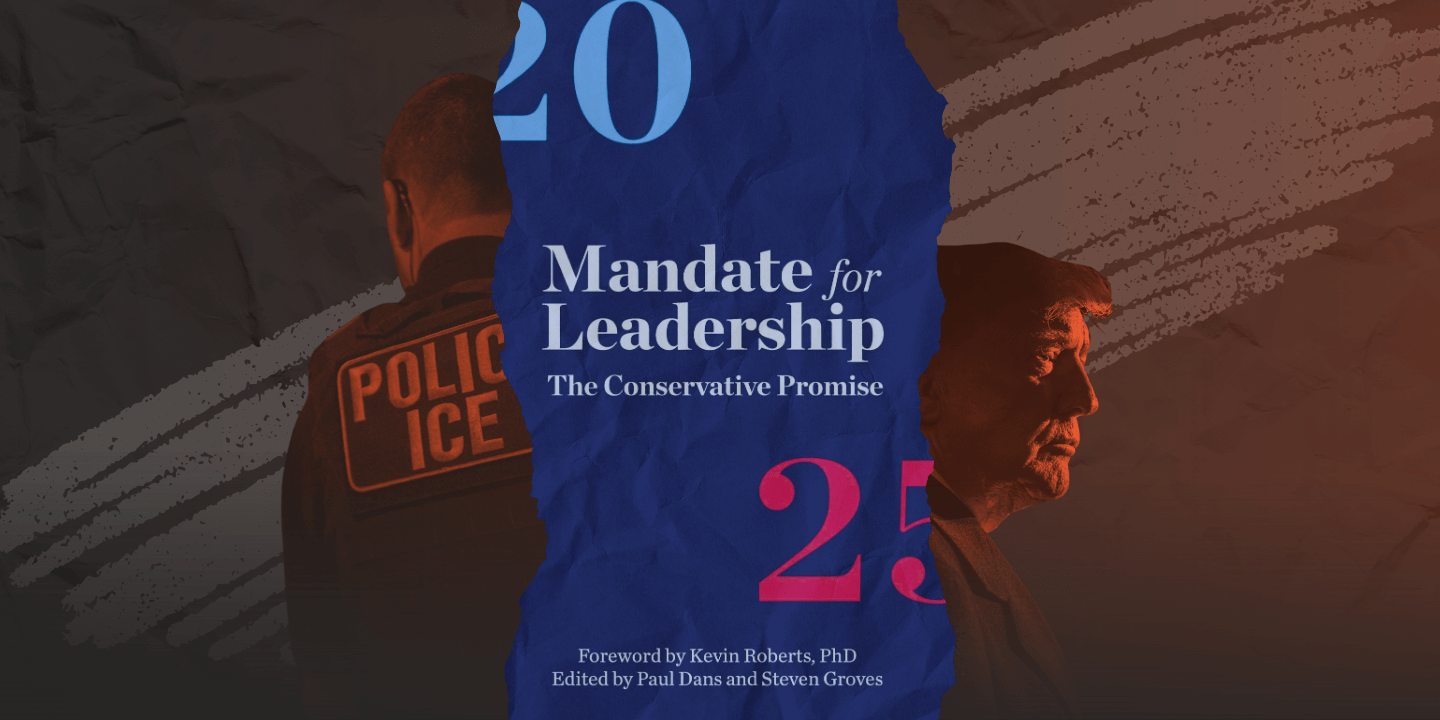
Tracking Project 2025: One Year Later – The Impact on AAPI Communities
Read an issue-by-issue breakdown of Project 2025, what it meant for AA/PI communities in 2025, and what it means in 2026.
Keeping Count | Five Ways Trump’s Agenda Impacted Asian Communities in 2025
We broke down five data trends that captured the urgent challenges our communities faced in 2025 and what we’re doing to fight back.
We are able to continue publishing research like this because of the generous support of people like you.
Your donation to Stop AAPI Hate helps us conduct research and analysis on AA/PI communities — and sustains our fight to build a fairer, more equitable future for all.

Keeping Count | Who are Hmong Americans? What’s Happening in Minnesota Explained