




Pacific Islanders face high levels of hate on top of long-standing structural inequities.
In Unsettled Waters: Anti-Pacific Islander Hate Amid Ongoing Justice, we delve into the current state of anti-Pacific Islander hate and the systemic forces of colonialism, militarization, and forced displacement that continue to shape the lives of Pacific Islanders in the U.S.
Download Resources
Nearly half of Pacific Islander (PI) adults experienced an act of hate due to their race, ethnicity, or nationality in 2024.
Pacific Islanders are included in the AA/PI umbrella, but the fact is PI communities, their histories, and distinct experiences are all too often overlooked.” As a result, there’s a lot we don’t know about anti-PI hate.
This report is one step towards changing that. In January 2025, we commissioned a national survey of 504 PI adults. Drawing on a combination of survey data and first-hand accounts from the Stop AAPI Hate reporting center, we learned that experiences of racism and discrimination are prevalent across PI communities. These experiences build on generations of colonialism, militarization, nuclear testing, forced displacement, and other structural inequities. Altogether, this created serious impacts on people’s mental health, financial situations, and everyday lives.
Keep reading for more about the state of anti-PI hate — including where it happens, what it looks like, and what we can do to address it.
Key Findings
Hate is common across Pacific Islander communities.
Anti-PI hate is a widespread problem. Nearly half (47%) of PI adults experienced some form of hate due to their race, ethnicity, or nationality in 2024. According to survey results, harassment is the most common form of anti-PI hate (41%) followed by institutional discrimination (27%) and physical harm or unwanted contact (23%).
They called me a Samoan sea n-gg-r outlaw.
– Gender identity not disclosed, Polynesian (2021)
In addition to facing high levels of hate online (48%) and in public spaces (44%), PI adults also experience high levels of hate at institutions like workplaces (38%) and businesses (37%). The high rate of institutional discrimination is notable and tracks with decades of racial and ethnic exclusion, which continue to limit PI communities’ access to healthcare, job opportunities, and higher education.
A LEGACY OF DISCRIMINATION
Beyond individual hate acts, PI communities also face structural violence, rooted in generations of colonialism, militarization, nuclear testing, and displacement. Here are several examples of how such forces continue to shape the lives of PI people.
- Colonialism: In 1899, Samoa was completely divided under the Tripartite Convention, through which the U.S. claimed the eastern islands (now referred to as American Samoa). Residents were designated as U.S. nationals without full rights and benefits as citizens, and the U.S. occupation restricted land use and altered the traditional Samoan way of life.
- Militarization: Declared a naval station and governed for decades by a U.S. naval governor, Guam’s indigenous CHamoru residents were denied civil rights and citizenship despite the military’s extensive use of their land and their own service in the armed forces. Although citizenship was eventually granted, CHamoru people remain politically disenfranchised and cannot vote in presidential elections while living on the island.
- Nuclear testing: In the 1940’s, the U.S. conducted nuclear tests across the Marshall Islands, which devastated the local environment and exposed Marshallese people to long-term health risks.
- Displacement: Dating back to the 1800’s, the U.S.-backed overthrow of the Hawaiian Kingdom led to the loss of Native Hawaiian sovereignty, the forced displacement of Native Hawaiians from their land, and the deliberate suppression of their language, culture, and self-determination.
Most Pacific Islander adults don’t report their hate experiences to formal authorities.
As common as it is, most cases of anti-PI hate go unreported. In fact, 61% of PI adults who experienced hate did not report it to formal authorities, such as a human resources department, the police, or a civil rights agency.
Of those who did report their experience, 21% reported to a criminal law enforcement agency (e.g., the police), and just 15% reported to a civil rights enforcement agency.
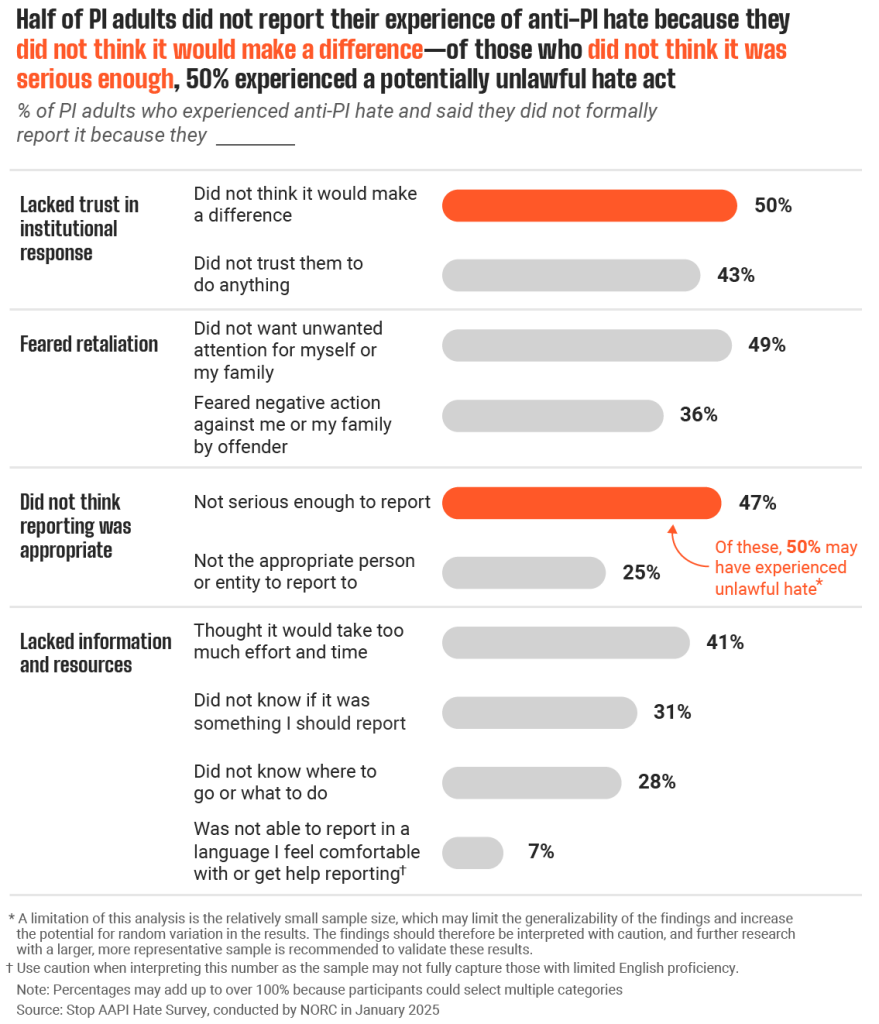
What keeps people from reporting hate? One explanation is a general distrust of institutional responses. Half (50%) of PI adults didn’t think reporting would make a difference and 43% said they didn’t trust the authorities to do something about it.
The origins of this distrust is complicated, but can be traced back to U.S. colonization, surveillance, and systemic discrimination against PIs.
PACIFIC ISLANDER COMMUNITIES AND POLICE VIOLENCE
PI communities face high rates of police violence and incarceration, contributing to their reluctance to trust or engage with the criminal justice system and the belief that the police do more to hurt their communities than help them.
➡️ PI people are more likely to lose their lives to police violence than any other racial group, and four times more likely to be killed by the police than white people.
Other factors that kept PI adults from reporting hate included the fear of unwanted attention (49%) and the belief that their individual case was not serious enough to warrant an official report (47%). It’s worth noting that of the respondents who felt their experience was not serious enough, 50% may have experienced an unlawful act.
Hate takes a toll on people’s mental and physical health.
Not only is hate pervasive across PI communities, it also has a negative impact on almost every aspect of people’s lives — most of all their health.

This builds on the impact of systemic inequalities like U.S. militarization, which leave PI communities susceptible to long-term health consequences.
PACIFIC ISLANDER COMMUNITIES AND PUBLIC HEALTH
A disproportionate number of PI people are either recruited to the military or athletic programs (e.g., the NFL), which leave them more susceptible to traumatic brain injuries, chronic pain, post-traumatic stress disorder, and other long-term health problems.
- Military enlistment: PI people serve in the military at a higher rate than any other racial group in the United States. At the same time, the military casualty rate for PI communities from the U.S. territories is higher than that of any U.S. state.
- NFL recruitment: Polynesian Americans — including Samoan Americans — are 28 times more likely to play football in the NFL than other ethnic groups. As a result, Samoan people constitute the most disproportionately overrepresented ethnic group in the league.
Victims and survivors are not getting their needs met.
Of the PI adults who experienced a hate act, over half (56%) said that they needed some form of support but did not receive it.
Even among those who received some form of support after experiencing a hate act, 72% said that at least one form of the support did not meet their needs. PI adults reported that the greatest areas of need include financial assistance (42%), mental health support (41%), and a supportive work or school environment (38%).

One possible explanation for the gap between what people need and what people receive is the lack of culturally responsive support (e.g., language accessibility, inclusion of traditional practices, and collective health decision making).
Other reasons support often fails to meet the needs of PI communities is the lack of awareness about where to seek help or whom to trust pointing to broader issues with accessibility and outreach.
Generational dynamics can also play a role in seeking support. Older PI generations may lack familiarity with mental health and wellness concepts due to persistent stigma and history of enduring hardships, while younger PI generations often shoulder heavy caregiving responsibilities that lead them to deprioritize their own self-care and delay seeking support.
Altogether, this report underscores the urgent need for more attention to the experiences of hate across PI communities and highlights their unique challenges combating racism in America.
We are able to continue publishing research like this because of the generous support of people like you.
Your donation to Stop AAPI Hate helps us conduct research and analysis on AA/PI communities — and sustains our fight to build a fairer, more equitable future for all.
Learn More
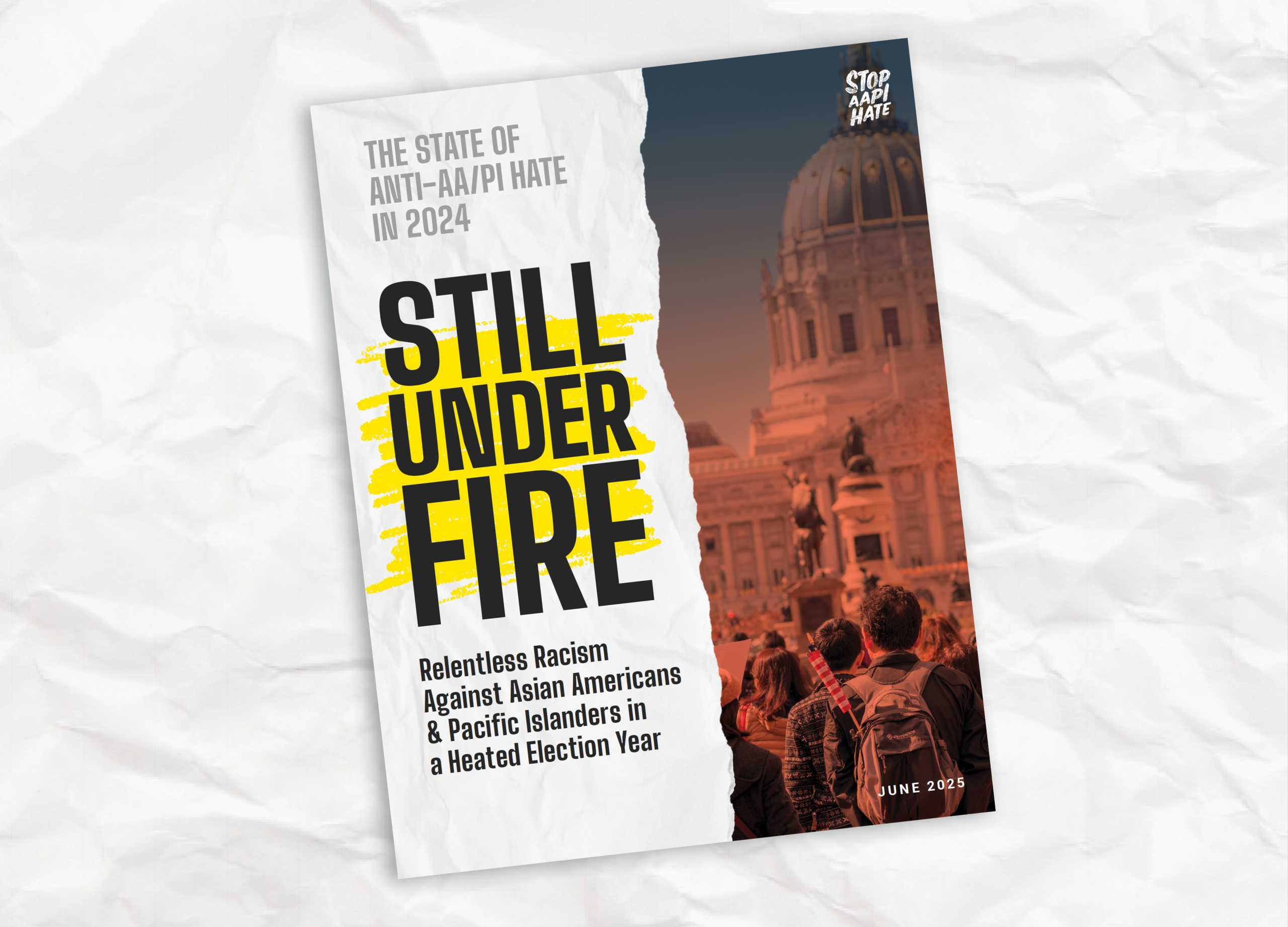
State of Anti-AA/PI Hate Report (2024)
Our second annual State of Hate report paints a sobering picture of widespread and persistent anti-AA/PI hate in 2024.

Report Anti-AA/PI Hate
If you see or experience an act of anti-AA/PI hate, take five minutes and submit a confidential report.
